


Hey DT Grown-Ups Table!
Last week’s exploration of Dorothea Lange’s photo captions inspired us! Writing about what you drew caused many of you to notice even more. Thank you for sharing your drawings and stories with us in the chat—we love these handmade peeks into the lives and natural surroundings of our GUT community!
Special notice to DC area folks: Wendy will be at the National Gallery of Art on Saturday, June 6, running her DrawTogether Strangers table. Don’t be a stranger! Come draw and say hi! More info here.
This week we have a radical drawing assignment, based on a small, unusual sketch Wendy saw in a Diego Rivera exhibit at SFMOMA. Grab a pencil, a few pieces of paper, some colors, and let’s do it.
It’s hip to be square!
From Wendy:
If there is one thing I learn over and over again, it’s get out there and look at art. Looking at art in books and online is a great intro, but we miss 87% of the work. Go to museums. Galleries. Mural-covered alleyways. When we’re physically in front of an artwork we can get up close, nearly touch our noses to the surface, and see how the artist made the thing. Line by line, stroke by stroke.
Or, as in today’s subject, square by square.
A few years ago, the SFMOMA had an awesome survey of Diego Rivera’s work. (For the uninitiated, here’s a documentary on the great Mexican muralist, aka Frida Kahlo’s husband.) While many gravitate towards the famous and ginormous Pan American Unity fresco, what captured Wendy’s attention wasn’t Rivera’s epic murals or historic paintings. It was this small sketch:
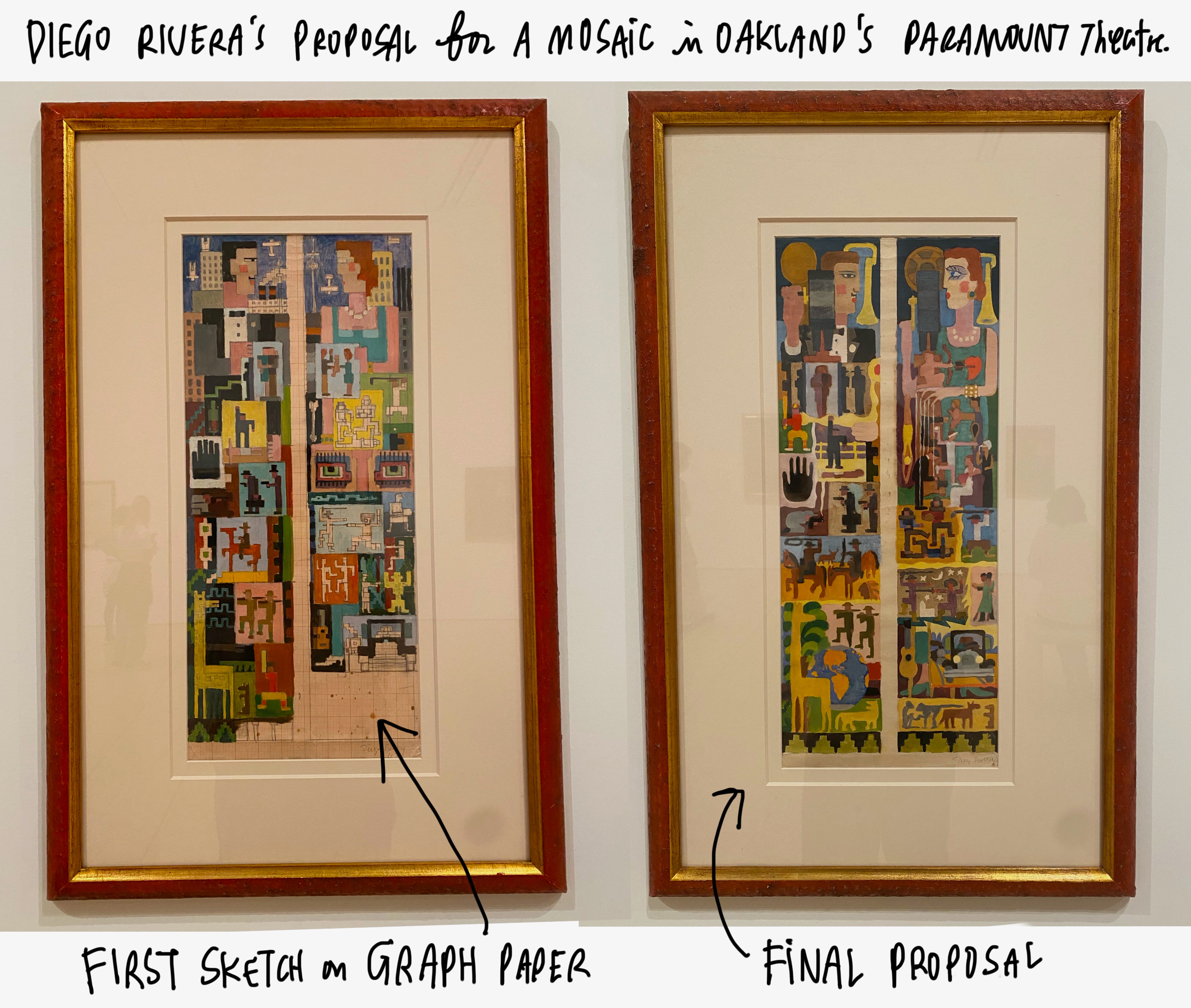
Diego Rivera typically worked in fresco for his murals (that’s where an artist paints into wet plaster on a wall). But when the Paramount Theater asked him to propose a mosaic for its facade, Rivera used pencil and gouache on graph paper for his pitch. (That’s right, even Rivera had to do proposals.) The sketches were designed to scale up to 100 feet. Fun fact: The architect did not accept Rivera’s proposal and went in another direction. (That’s right, even Rivera got rejected.)
How Rivera used graph paper to work out his subject is mesmerizing—the composition and the mosaic’s pixelated form. We often celebrate an unrestricted blank page and fluid lines, but what would it be like to simplify a drawing down to tiny building blocks?
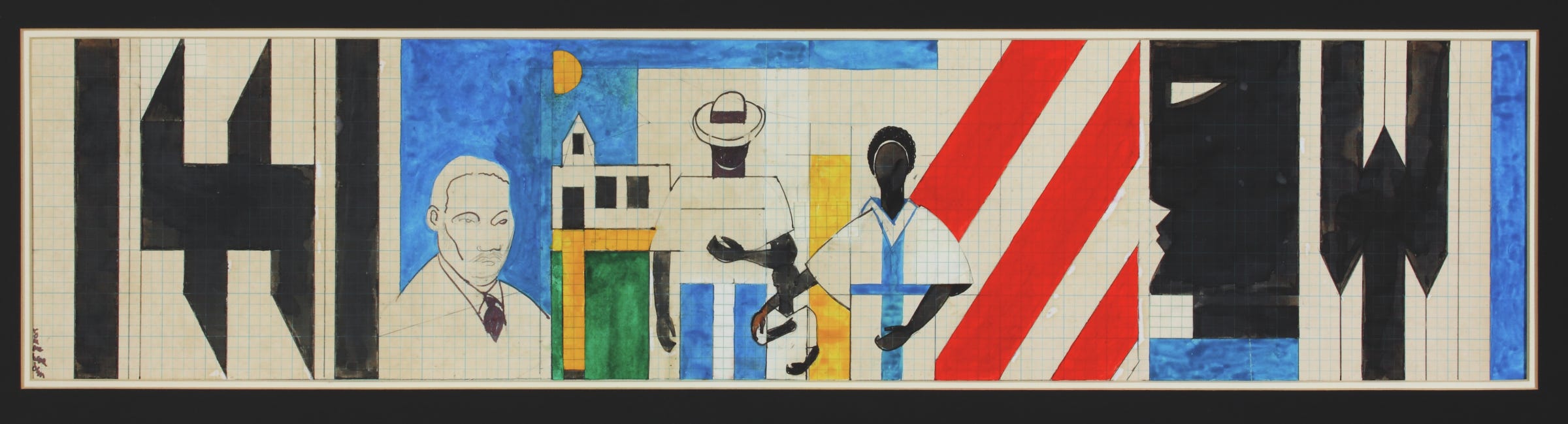
Many artists work out their ideas on graph paper. Below is a study that artist Romare Bearden did for a mural. You can see where he used the grid to plan out spacing or shapes. Notice how Romare’s human figures both play into the grid—particularly the clothing and bodies of the middle and far right individuals—and diverge from the grid, to add more detailed features and hands.
So, my Grown-Ups Table peeps, grab your supplies. Let’s get square.
