

Kicking off the GUT Permanent Collection
Drawing with scissors, featuring Romare Bearden

Helllloooo, my dear Grown-Ups Table friends,
We’reeee baaaaccckkkk!
I missed you. Our 2026 30 Days of Drawing was EPIC, and we heard from a lot of you saying it was our best year yet. So happy to hear it. Also, we really needed that break afterwards to catch up on rest and life. Maybe you did, too.
I’ve been lurking in the chat and it’s been great to see members continue to share artwork, and in-person DrawTogether groups start to meet up! Remember, if you are interested in drawing IRL with GUT members, here is the thread to connect.
Big News Alert:
Alright, I have some super exciting news to share with JUST folks here at DrawTogether/The GUT. I am not posting this on social media. No press announcement. No skywriting. This is exclusively for you because this announcement is deeply connected to what we do together at the GUT: I AM WORKING ON A BIG BOOK. 🎉🎉🎉🎉🎉
This book is the most meaningful, challenging, fun, exciting, and daunting thing I’ve ever made. Ever. And YOU are a part of it. WE are a part of it. You’ll see. My wonderful editor won’t let me say more, but I promise you it will be well worth the wait.
Got questions? Comments? (Be kind, please. A book is hard!) You know what to do:
Also, it turns out the writing and drawing of a book is a total commitment. (Yup, I’m doing both.) It requires a kind of singular focus I’ve never had to summon before. In order to do it, I’m heading off into the woods (quite literally, Thoreau-style) to give it my all for a little while. In the meantime, we will share some of our favorite DT/GUT drawing lessons and assignments in a special series we are calling “Selections from The GUT Permanent Collection.” It’s a great chance to practice some of my favorite lessons and drawing practices from the past six (!) years, with a few bonus twists and tricks to keep you on your toes.
I promise to do my very best to return with a book worthy of your time and attention. And I promise you will see YOURSELF in its pages. Our community has taught me so much, and together we have a lot to teach the world. So stick with me, folks. Soon, the world will be Drawing Together. :)
Sound good? Before I kick us off, a quick reminder: This is the last week to access the posts and assignments from this year’s 30 Days of Drawing! They will be archived on Saturday, February 28. If you missed the celebratory closing Zoom, you can watch the recording here.
And so, without further ado, my dear GUT peeps, may I introduce…
Let’s do this.
With February being Black History Month, we wanted to bring back a favorite dispatch of mine: a collaboration between the GUT and the National Gallery of Art, celebrating the life and work of Romare Bearden. An artist and activist, Bearden is best known for his collages depicting the lives and experiences of Black Americans.
“My purpose is to paint the life of my people as I know it.” — Romare Bearden

Who was Romare Bearden?
Born September 2, 1911, in Charlotte, North Carolina, Romare Bearden was of Cherokee, Italian, and African descent. He was the only child of college-educated, middle-class parents. But even for Black families who’d attained a measure of stability and status, life in the Jim Crow South was limiting, oppressive, and often violent.
When Bearden was three, his family joined the Great Migration—the journey taken by some 6 million Black Americans out of the constrictions of the South. Bearden’s family made their way to New York, eventually settling in Harlem.
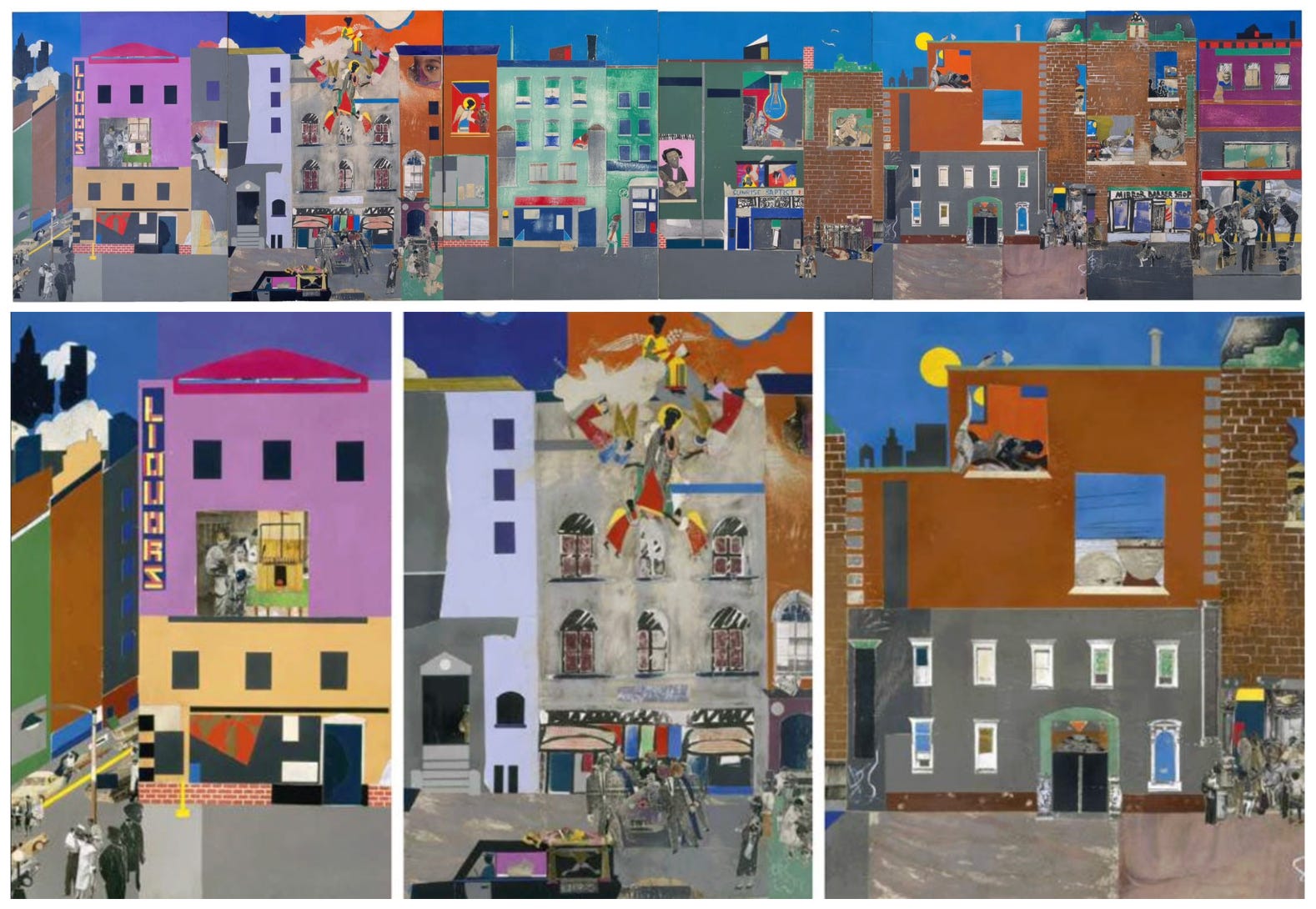
In 1920, Harlem was an epicenter of music, art, and culture—and Bearden’s family was in the thick of it. A newspaper columnist and civic and political activist, his mother was a local powerhouse. She and her husband hosted cultural icons, such as W. E. B. Du Bois, Duke Ellington, and Langston Hughes.
After impromptu art lessons from a neighbor at age 14, Bearden began studying painting and drawing seriously. He attended New York University, where he met Elmer Simms Campbell, the first Black cartoonist for publications like the Saturday Evening Post and the New Yorker. It was a life-changing friendship. Bearden began making cartoons and illustrations for publications such as the NAACP’s magazine The Crisis.
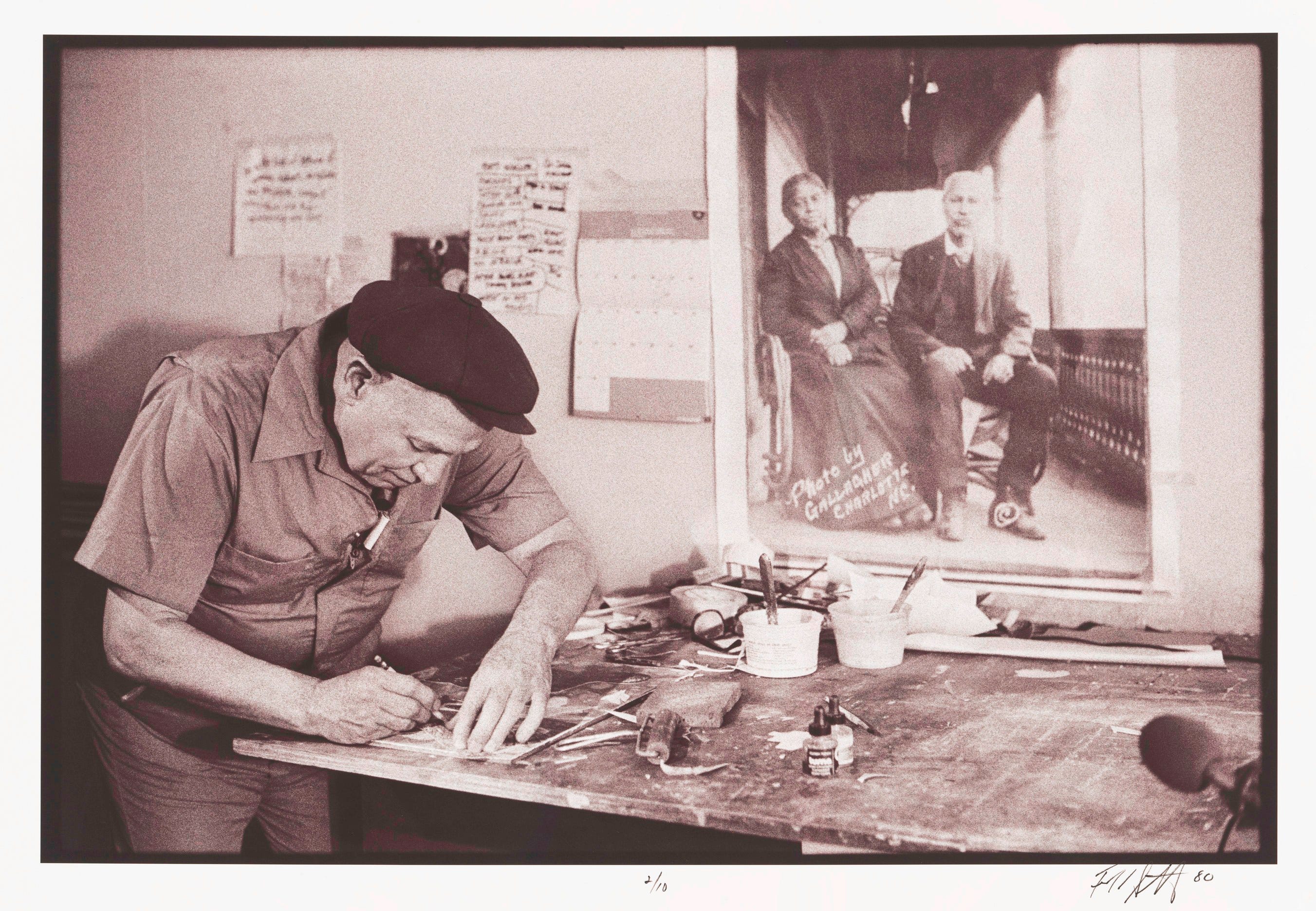
After graduating from NYU in 1935, he continued taking classes at the Art Students League of New York. To support himself, he became a (drum roll….) case worker for the city’s department of social services! That’s right: He served the city as a social worker for almost three decades. A little aside: If you’re familiar with our fearless leader, Wendy, you probably know she’s also a trained social worker!
Bearden continued his case work until just two years before his solo exhibition at the Museum of Modern Art in 1971! And he was only the second Black artist to have a solo show at MoMA.
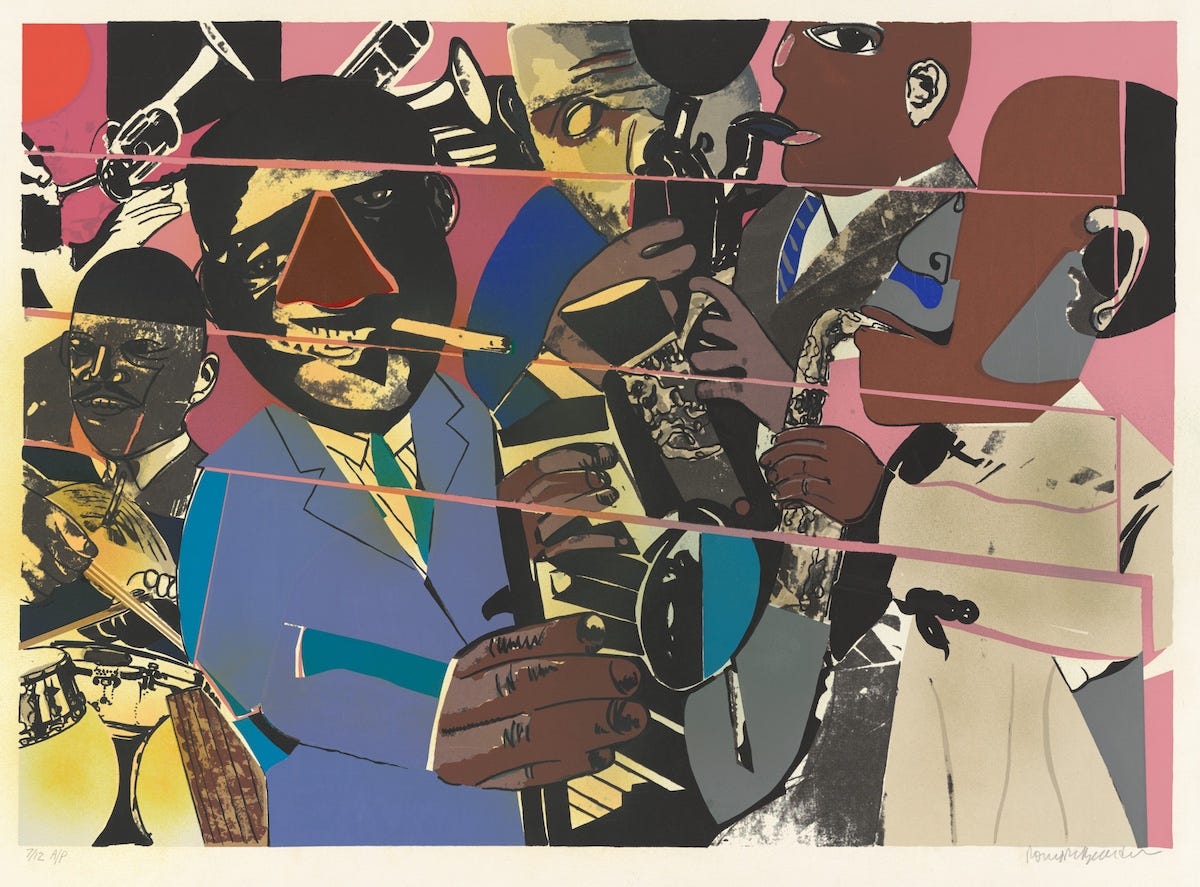
How did Bearden begin collaging?
“People have asked me why I use the collage. I find that when some detail such as a hand or an eye is taken out of its original context and placed in a different space and form configuration, it acquires a different quality. In such a process the meaning is extended.” – Romare Bearden
Fun fact: Bearden didn’t start working with collage until he was 53 years old. The word collage comes for the French word “coller,” meaning “to glue.” Collaging is the practice of assembling, arranging, and adhering smaller pieces together to create a larger whole.
Until the mid-1960s, Bearden focused almost exclusively on painting and drawing. That all changed after he began gathering with other Black artists, including Ernest Crichlow, Norman Lewis, and Richard Mayhew, to discuss how they, as artists, could support the civil rights movement. They formed Spiral, an artists’ collective, and Bearden suggested the group collaborate on a piece, offering collage as a medium. While Spiral did not take up that project, the conversation sparked Bearden’s interest in experimenting with collage himself.
Bearden went straight to work in his studio and produced a series of small, vibrant collages. Pulling from many different sources and using colorful, patterned papers, he focused these works on the vibrant Black life at the time. Those collages launched the huge body of work he is known for today.


What a great reminder that failure only happens when we stop trying. We never know what we are going to make next, as long as we keep creating. Romare’s idea for a group project was rejected, but it opened the door for a lifetime of his own artwork. Challenges = creative opportunities.
Bearden passed away in 1988 at the age of 76, in Harlem. He was making art until the day he died.
Tomorrow I May Be Far Away
One of Bearden’s most famous collages, Tomorrow I May Be Far Away, is in the National Gallery’s collection. And it is a giant. Measuring 46 by 56 inches, it’s made with various papers, charcoal, graphite, and paint on paper mounted to canvas. You can get a sense of it in the image below, but you really have to see it up close to appreciate the intricacy and complexity. It’s clear how much time and care Bearden took.
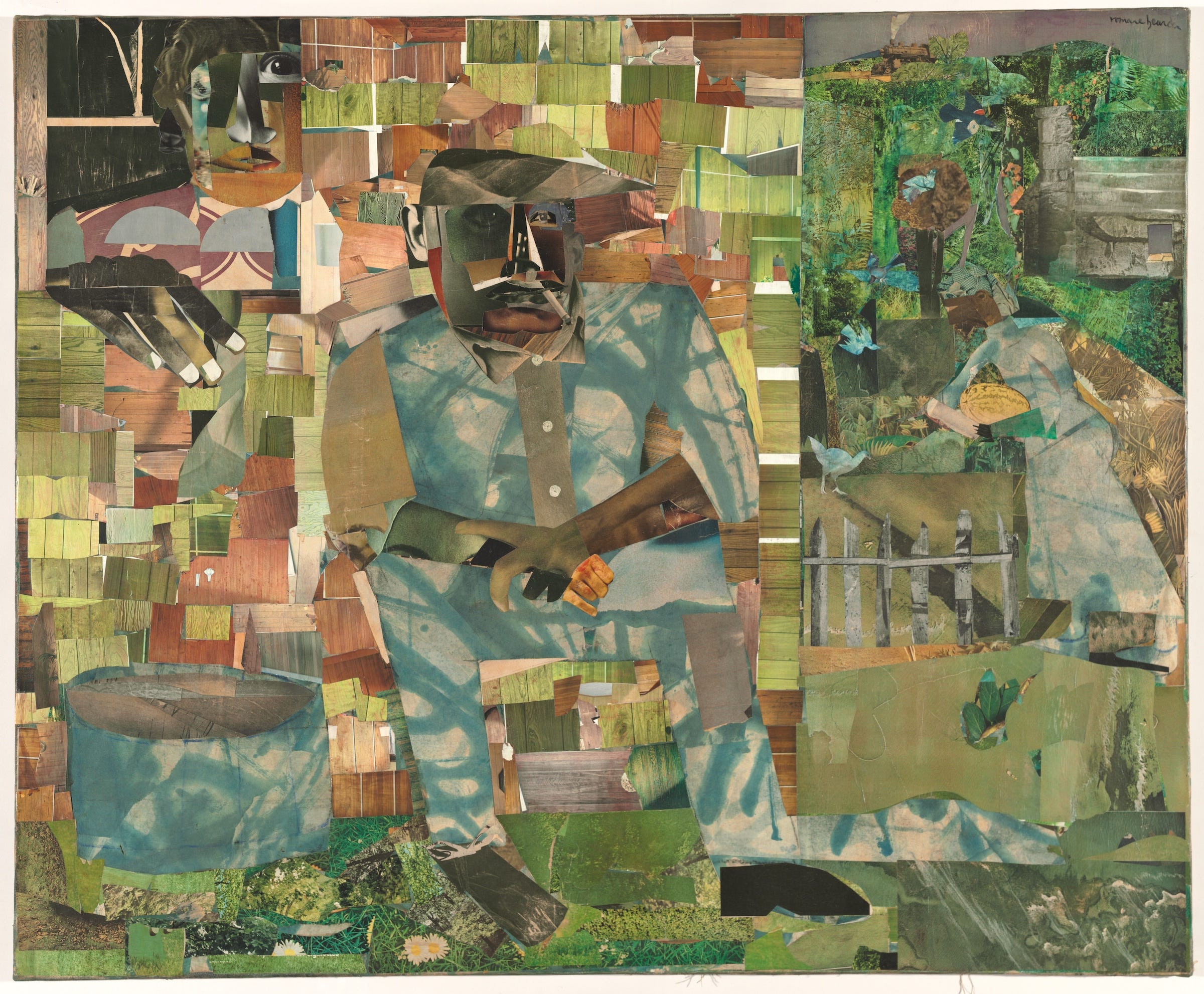
Bearden’s influences were deep and wide, often tied to his own memories. Take a look at the patterned paper all around the main figure in the piece. Bearden used cutouts to create a shingled building, typical in Mecklenburg County, North Carolina, where he was born. Even after settling in Harlem, Bearden often visited family in the South.
He also looked to art history—both European and African—and Black culture, literature, and music like jazz and the blues. The work’s title, Tomorrow I May Be Far Away, is a lyric from the song “Good Chib Blues,” recorded in 1929 by Edith Johnson. Take a listen below. You can imagine Bearden hearing this music while piecing together this collage in his studio. Using the lyrics as his title makes music a medium in the work. Truly multi-media.
This piece summons the memories, textures, and half-remembered fragments we carry with us—the ones that quietly shape who we are. It calls us back to family, to community, to the particular feeling of childhood that still lives somewhere inside us.
How about you?
With that dose of inspiration, let’s pick up our papers, newspapers, magazines, catalogs, wrapping paper, and painted bits and bobs—and draw with our scissors…