


My Grown-Ups Table friends!
As of right now, you are four days into the 30 Days. That is over 1/8 of the way there. Look at you, showing up every day to draw. GOOD JOB.
For members who missed our 30 Day Zoom kick-off and/or who want to watch again and draw with Julia Rothman and me, you can find a link to the recording below today’s assignment. This is members-only, and we will do more of them, so just sayin’…
The past few days have been warm-up focused: setting our intentions, getting our eyes and hands in sync, getting into the rhythm of 10 minutes a day of drawing.
From here on out, every week will have a new theme: I’ll give you a deeper lesson on Sunday, then follow it up with little bites every day through the week. Remember, this year LESS = MORE. Take a breath. Go easy. If you fall off one day, no biggie. Just start up again the next day. I’ll be here, ready to draw with you.
NOTE: If you’re just lurking and don’t want to draw, that is great! Thanks to paying subscribers, I can keep the lessons free for all. I want everyone to benefit from the art learnin’. And if you DO want to draw, great. This is the last day to join the community at the way cheaper price, so jump on this:
30 Day Big Picture Check in
Here are a few questions you can ask yourself to help set you up for success for the rest of the 30 Day:
Where can I leave my sketchbook and drawing tools out and visible so they are always present and ready? We are more likely to do things if we see them.
What is a ritual I can create to accompany my 10 minutes of drawing? Make a cup of tea? Or a snack? Light a candle? Rituals can be so useful in creating and maintaining a drawing practice.
Can I create a regular time and place to draw every day for 10 minutes?
Is there a buddy I can ask to do this with me? Everything is way more fun with a friend.
Speaking of fun, that is just what we’re gong to focus on this week: PLAY.
Every day this week, I’m giving you a new drawing exercise to help you shift into a playful, free, expressive, curious frame of mind. Yes, there is an awful lot going on in the world. Yes, it can be overwhelming. And this is exactly when we need to carve out time to become more mindful, more curious, and more playful. Not to turn away from the hard stuff, but to be more fully present to everything.
Drawing is the best way I know how to learn to be more present.
I hope our ten minutes a day of drawing helps you grow that presence, too.
And with that, let’s get into…
PLAY
“It took me four years to paint like Raphael, but a lifetime to paint like a child.” — Picasso
A couple weeks ago, I was at a latke party sitting on the couch, stuffing my face with fried, shredded potatoes, chatting with the mom of a three-year-old playing nearby. I watched as the kid dragged two wooden chairs across the floor and placed them next to each other. He twisted one this way, the other that. He pulled one back and the other to the side. He checked them again and again, until they were just right. “Nice chairs,” I said. He ignored me. “Are those your chairs?” Still, ignored me. “What are you building?” I asked. DING DING DING! He jumped in between the two and put his arms in front of him and yelled, “PLANE!!!!””
When did we stop believing chairs could be airplane wings? Somewhere, at some point, for most of us, our imagination and curiosity was replaced by practicality and predictability. We stopped playing for the sake of play. Many of us stop playing, period. Why?
A couple years ago, I got curious about the intersection between drawing and FUN, and I reached out to my pal Catherine Price, author of the book The Power of FUN (and co-author, with Jonathan Haidt, of the just-released essential kids book The Amazing Generation: Your Guide to Fun and Freedom in a Screen-Filled World!). I’d included Catherine’s expert take on the importance of fun in a piece I did for the New York Times called “How to Have Fun Again” so she seemed like the right person to ask.
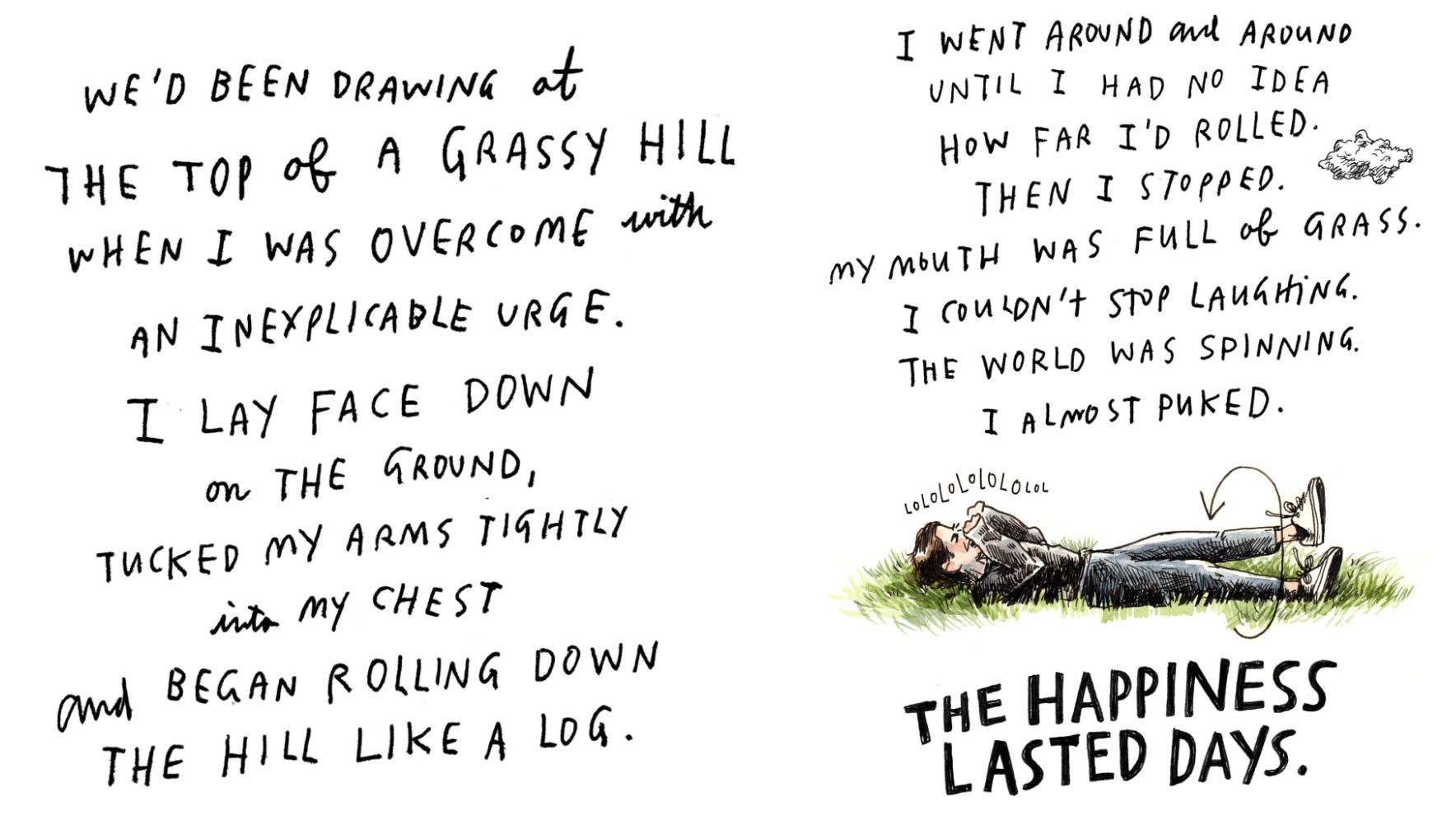
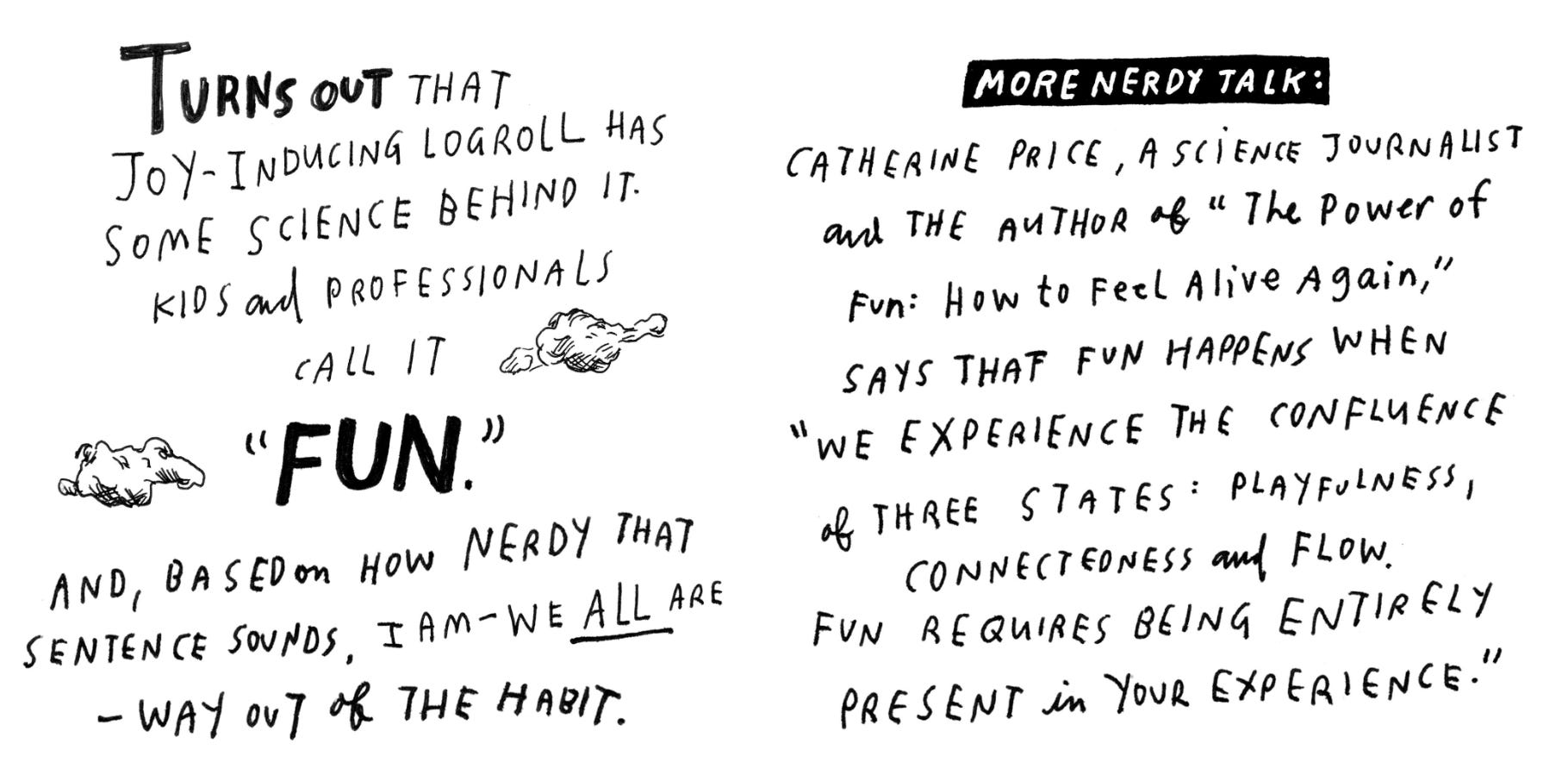
Catherine told me, fun exists at the intersection of “Playfulness, Connection and Flow.”
When we play, we don’t take ourselves too seriously. We find ways to laugh. We get out of our own way and silence our inner critics. It is CRUCIAL to have fun.”
I find that when we draw in a way that releases perfectionism and judgment, we cultivate that kind of playfulness.
So what exactly is playfulness?
Catherine recently did a great interview on her Substack with the incredible designer Cas Holman, author of the book Playful.
Cas explained to Catherine that children “are wired for free play.” It’s how they learn about the world. They are curious, non-judgmental, and experience delight from most outcomes. THAT is how a child plays. Play for them is not about getting anything “right.” It’s motivated by internal curiosity and joyful results. As we get older, things change. We get messages from outside ourselves that judge our behavior, tell us what we are good or bad at, what we should or shouldn’t do, and we shift our behaviors to meet those expectations. We shift away from play.
Most of the things we do as adults are usually motivated by extrinsic motivation: pleasing someone, making money, garnering praise, avoiding shame, things like that. All these things shift us away from that early state of play — a frame of mind that is inherently messy, unproductive, inefficient, and… joyful. Play is FUN.
DRAWING is one way to re-enter a state of play as a grown-up. But in order to do that, we have to let go of some pretty constricting extrinsic motivations: expectations that a drawing should be “good,” that there is a “correct” way to draw, and that anyone is going to judge us for it.
Well, GUT crew, time to let those fears go. This week, you are going to make some REALLY silly drawings. Many will NOT be good. They will NOT be correct. And guess what?? NOBODY CARES. In fact, if you share your drawings in the chat (which I hope you do) the only external approval you will get is for doing it. The point is to have FUN doing it, make something SILLY, and PLAY.
Sound good?
A little plug for both these smart people: You can learn more about F-U-N from Catherine in her interview with NPR’s “Consider This” and read her great NYT piece. And you can learn more about Cas on her website and watch the awesome episode of the Netflix show Abstract: The Art of Design that features her and her amazing work!!!
Play drawing number one: Blind Contour
Today we are diving into my favorite-for-a-million-reasons drawing practice. That’s right. Today we’re doing BLIND CONTOURS.
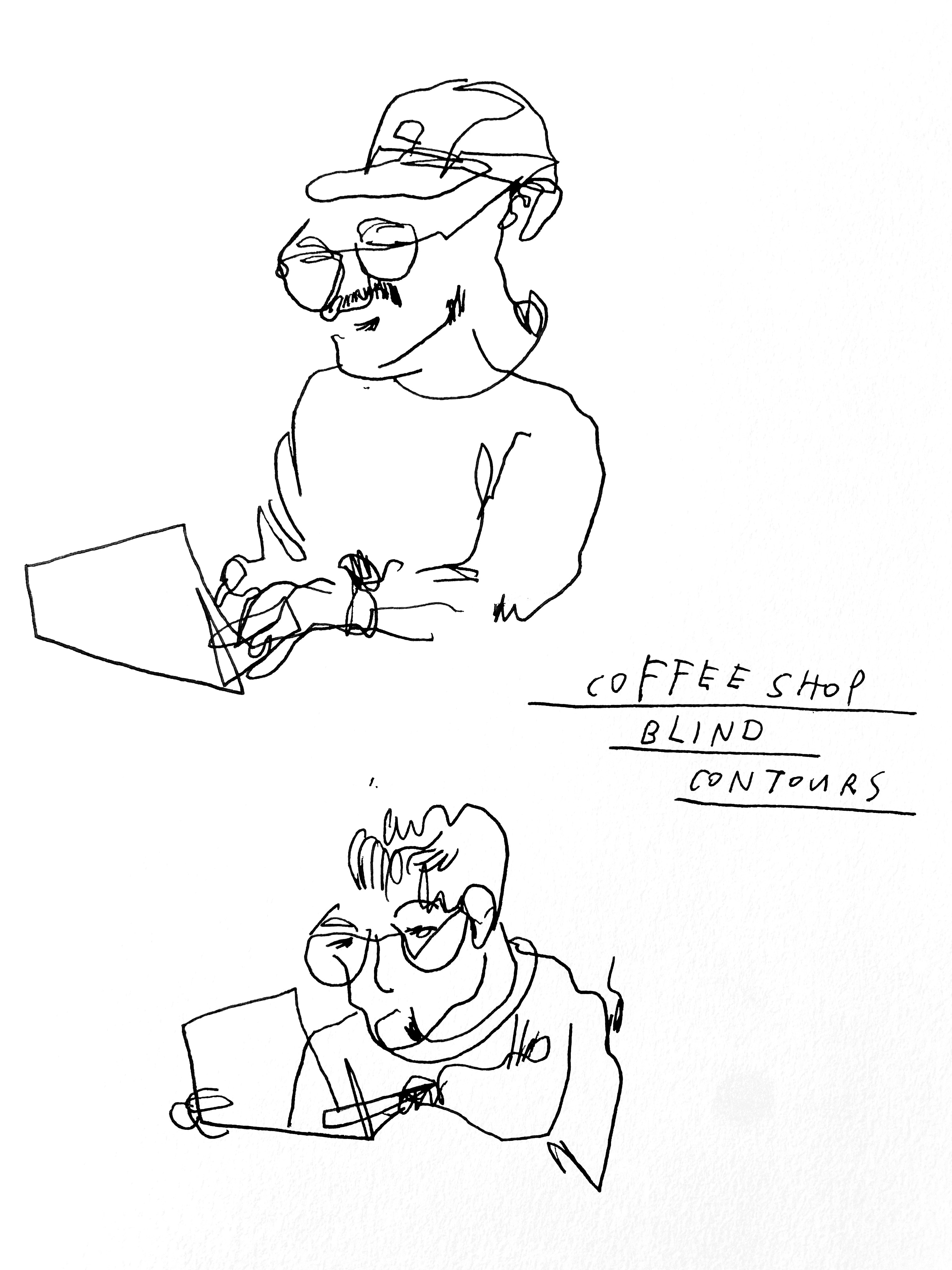
Oh, yes, friend. If you’ve drawn with me for any length of time, you know this practice well. And you know how important it is to me, and how fun it is.
A Blind Contour is a drawing created with one rule: While drawing you can ONLY look at your subject matter — and you can NEVER LOOK DOWN AT THE PAPER YOU ARE DRAWING ON. This forces us to look super closely at what we are drawing, and trust our hands to follow our eyes.
Not only does blind contour drawing help connect our eyes and hands which helps increase our drawing skill — it teaches us to SEE again.
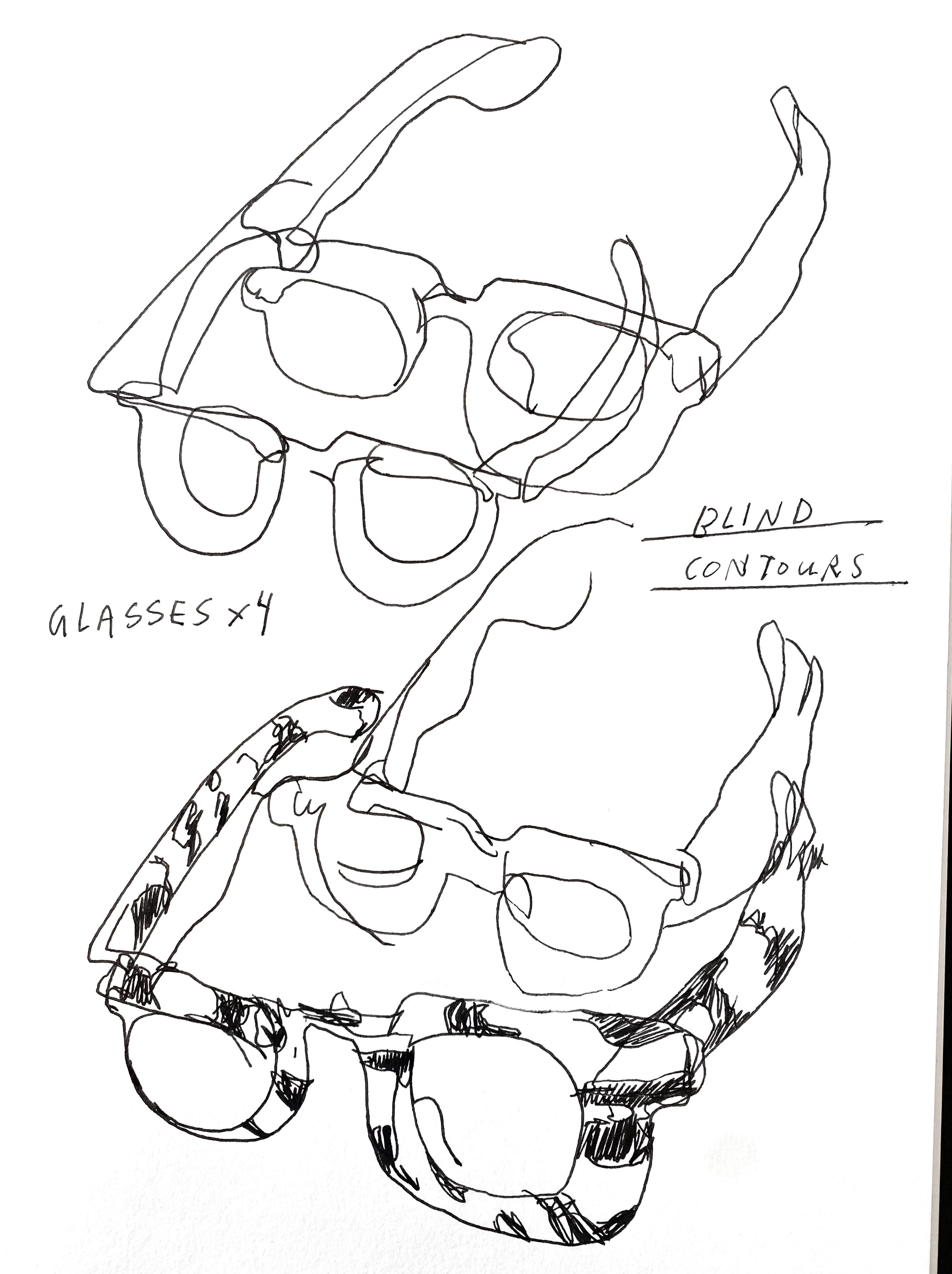
I know it looks loose and silly and the opposite of “serious drawing.” But honestly, I think blind contour drawing is the most important transformative drawing practice on Earth. Not only does blind contour drawing help connect our eyes and hands which helps increase our drawing skill, it teaches us to SEE again. We rarely slow down our eyes and really LOOK at what — and who — is in front of us. When we do, we begin to question and undo biases and expectations of what — and who — we’re looking at. We begin to connect with them from a place of curiosity and vulnerability and authenticity. This, my friends, is called connecting. And that changes EVERYTHING.
Blind contour drawing allows us to let go of expectations of doing a “good drawing” and focus exclusively on process.
ALSO, unlike traditional contour drawing, there is NO WAY a blind contour drawing can look “right.” It’s going to look ridiculous. What a relief! Blind contour drawing allows us to let go of expectations of doing a “good drawing” and focus exclusively on process. Process over outcome, y’all! GUT MOTTO.
Whenever I give a talk I make the audience do blind contour drawings, like I did at the beginning of my TED talk (which is somehow over 4M views?! I’m heartened that so many people are becoming interested in drawing!!)
That practice evolved into the ongoing social art experiment/practice/experience DrawTogether Strangers, which is truly the clearest distillation of all my work — BUT THAT IS ANOTHER STORY. Back to blind contour:
Not only does blind contour drawing teach us to see, but it is also a LOT of fun to do. It forces us to slow down, pay attention, let go of expectations, control and perfection and just DRAW. It is super duper fun play.
Today, we start to PLAY THROUGH DRAWING. All you need is a paper, pen, colors, and a subject. It could be a plant, a nearby item, even a person. Or it could be so idiosyncratic a subject that you’ll always recognize it, no matter how silly your drawing turns out. It could even be… YOU.
Here is today’s assignment:
