


Hellloooo my GUT-sters!
Can you believe it’s Day 27?? Can you feel your DNA shifting? Are you seeing compositions and meaning and beauty everywhere? Have your fingers become pencils?? I probably should’ve warned you: that happens.
Yesterday we learned a little about lettering. You can use your new lettering skills any day this week, or decide you’d like to stick with drawing images only. You. Do. You.
Today, we start to explore documentation through drawing. We start with a simple four-panel comic. As always, these do not have to be “good drawings.” In fact, there’s practically no way they can be in 10 minutes — that’s just two-and-a-half minutes per piece! Short drawings like this are similar to those thumbnails we made in our Drawing Basics week: We are just using our hands to remember, and getting visual memories and ideas down on paper. This practice introduces us to the possibility of keeping a visual journal of our days, and how drawing can help remember, notice, think, and communicate.
Okay, let’s dive in.
Four-panel comic journaling
Format
Before I start drawing or writing, I like to know what I’m working with. In the case of a sequential comic, that means frames. WAIT. HOLD UP, WENDY. What is a sequential comic? Great question. A sequential comic is a drawn story made up of two or more panels, and when you read the panels in order they tell a story. Make sense?
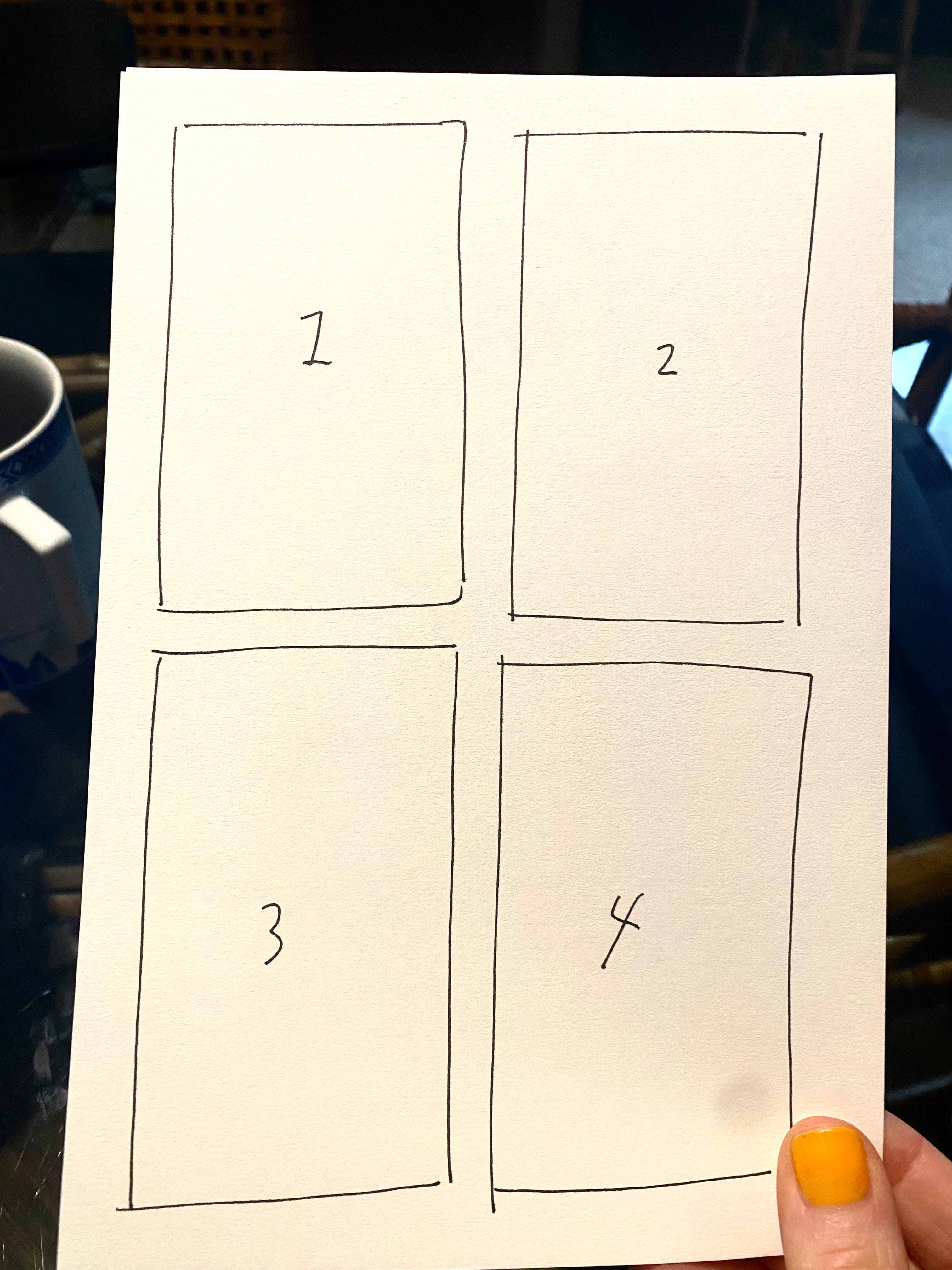
So first things first, let’s draw our four frames. I’m going to do TWO examples, and you can choose which one works for you. (Or make up some other one!)
DO NOT DRAW THE NUMBERS IN YOURS. I am just including them in my examples so you can see the order in which they will be read, sequentially.
Here’s option one, which is a pretty traditional western approach to layout.
Here’s option two.
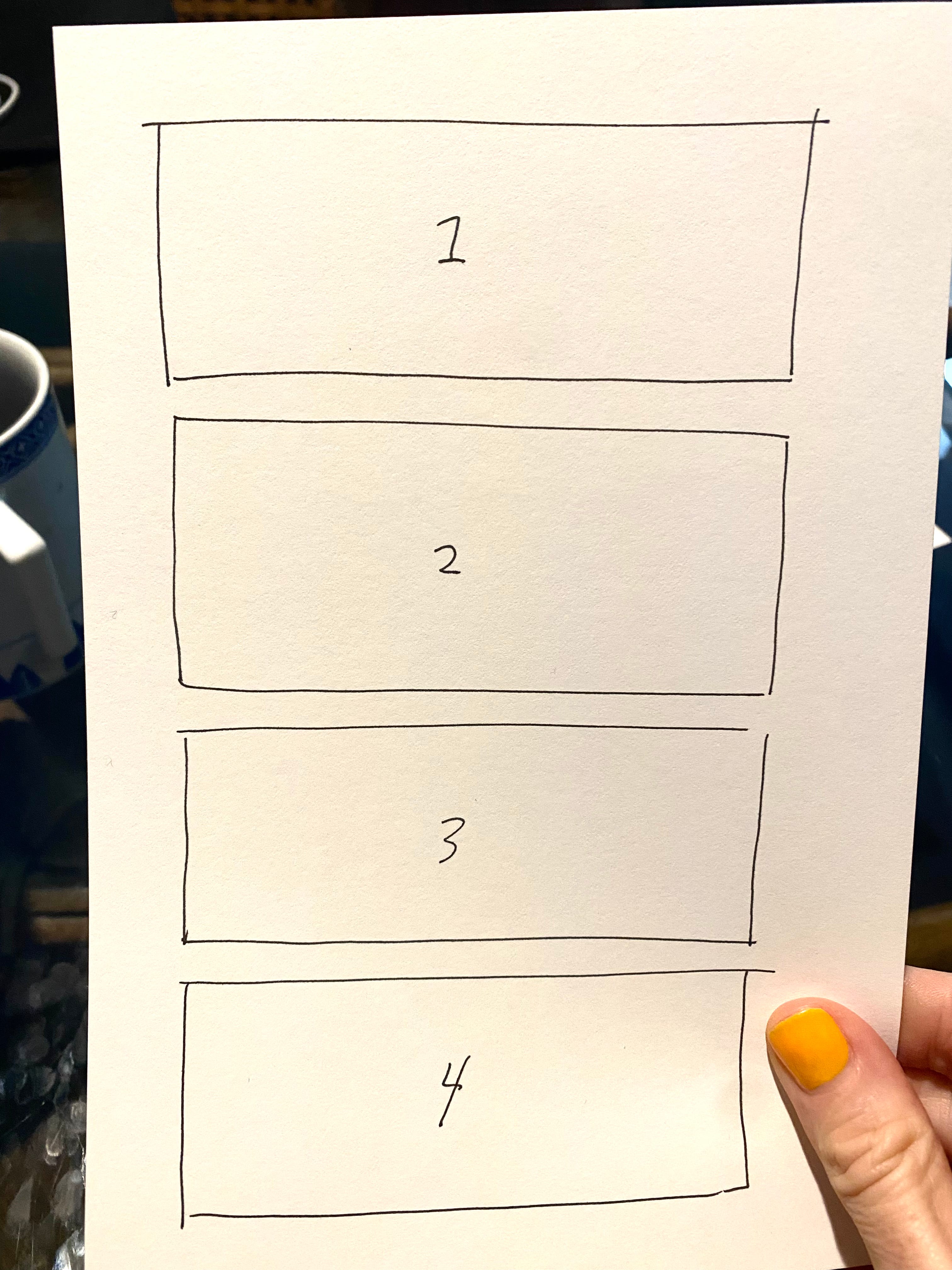
All that matters is that you have four boxes, and that they can be read in an order that works for you.
Next step: What goes in the boxes? If we are drawing our days, we first have to remember what happened. If you are doing it in real time, great! If you are documenting a previous day, do a little review. Try writing down memories of the day before. Maybe 5-10.
Now, choose FOUR items from your list. Maybe they are the four that stand out the most. Or that represent how you’re feeling, or the main thing occupying your brain/heart/time/space. Or maybe there’s a theme. Food? Locations? People? Conversations? What you read or watched of listened to? Or maybe it’s just random. Whatever you want to focus on, choose four. And then…
Draw your day
If you just got anxious thinking “I don’t know how to draw these things!” I GET IT! It feels HARD to draw scenes from life. People feel hard to draw. Settings feel confusing! BUT WAIT. Hold on. Remember: You know how to do this! You have done it all already! A couple weeks ago you learned to draw that Ivan Brunetti style person. You can just do that again! And this is not about getting it “right” — this is about moving your hands to remember. So if you want to feel free, you can draw with your eyes closed, or do a blind contour. Or just use your words!! You have so many tools in your toolbox now. Most of all you have the tool of letting-go-of-expectations-and-focusing-on-the-process. You’ve got this.
Alright here, is my four-panel comic journal using that first layout…
