


Helllooooo GUT crew!
Before we dive into today’s lesson and assignment, I want to take a moment to acknowledge what’s happening in the U.S. and around the world right now. This is a very scary time, full of fear, uncertainty, and attacks on human rights. I was talking with a friend a couple days ago about the threats facing our neighbors, our friends, our families, and ourselves. In desperation, I asked, “What can we do?” She snapped back, “Your GUT community is doing it! Get people to draw and see each other.” In challenging times, it’s helpful to be reminded of our deeper purpose. So this feels like a good time to share my/DrawTogether’s mission again — a reminder to you, the whole DrawTogether community, and myself. There is more direct action, too. But this is a very solid foundation for change:
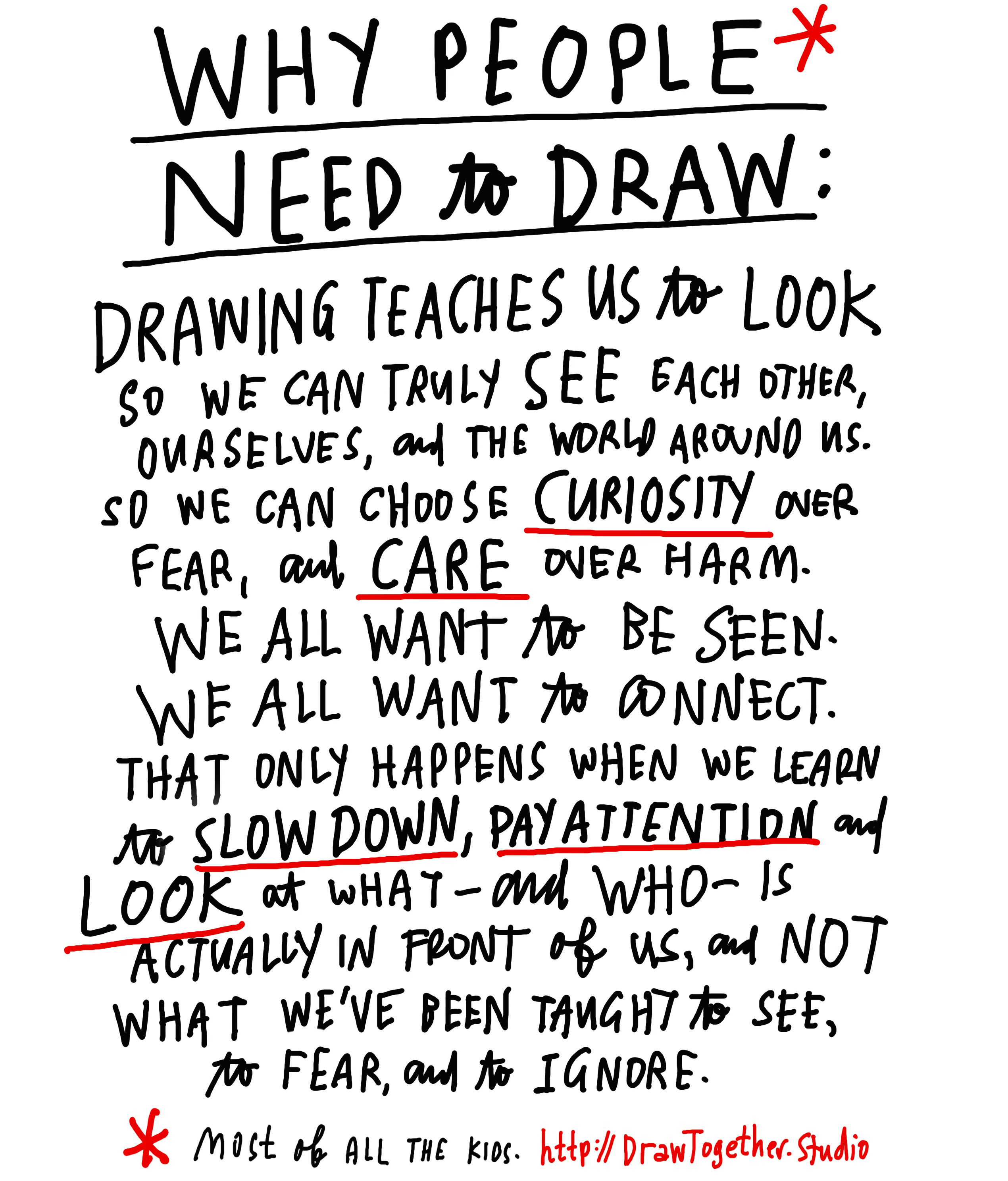
Sure it’s fun and playful, but what you’re doing here matters. You are rewiring your brain for curiosity, attention, and care. With that in mind, today’s lesson is about learning to look closely and see what is not there. It feels like a very fitting lesson for this moment.
Alright, new day, new way of looking at the world. Remember “opposite day” in elementary school? Today is similar. It’s negative day in GUT Drawing Basics. The day where we only draw the things we cannot see.
Our focus: negative space, aka the space AROUND our subject. We make the empty space the subject as much as the subject itself.
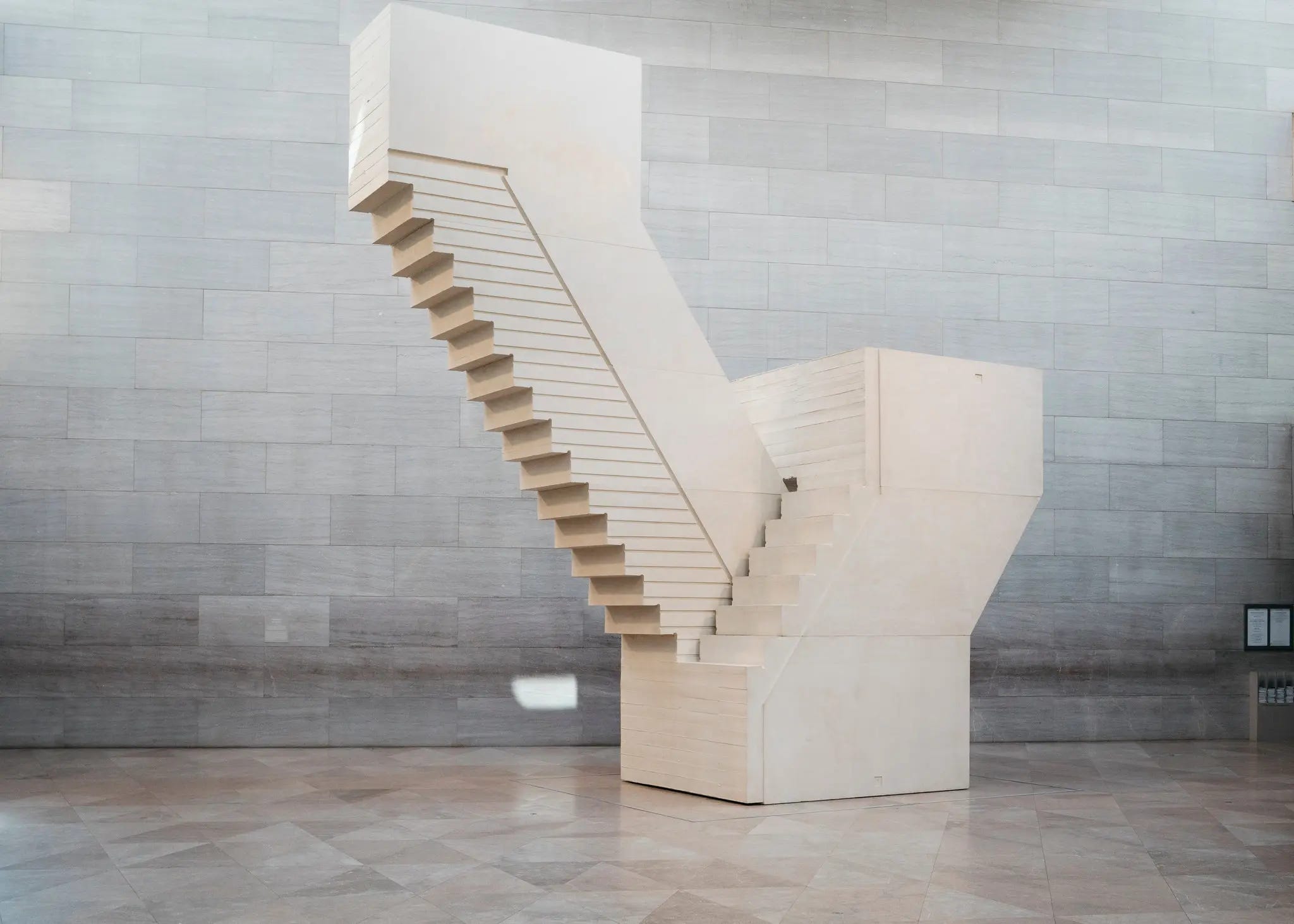
Imagine a classical European oil portrait of a silly looking, self-serious person in front of a dark background. The subject is the person and the space around the person is the negative space.
Subject = positive space. Area around the subject = negative space.
Negative space performs many functions. It focuses our eyes on the subject, it keeps our eyes moving or holds them still, it allows for visual space/room to breathe, and sometimes it gives the subject an extra layer of meaning. For example, have you seen this logo before?

Sure, a million times. Have you ever noticed the hidden symbol in the logo? Focus your attention on the negative space of the logo — the space between the letters. See it, between the E and the X?? YES. It’s subtle — took me YEARS to see it. But once you see that arrow. In this case, the designer/ad guy used the negative space to create an image that informs the meaning of the subject. An arrow takes your package from here to there. Very clever, ad guy/designer.
Spatial elements in drawing
First, a little primer on the spatial elements in drawing. Composition is how elements are arranged in space. That could be on a canvas, on a piece of paper, in a room, etc. In every composition there are three spatial elements: positive space (subjects), negative space (the space around the subjects), and the frame (the boundaries of the paper/canvas/room you are working within.) Working with those three elements you can do anything you want, but they will always always always be working together, and how you arrange them creates harmony, tension, focus, overwhelm, you name it. But you can never have one without the others.1
Here is an example by one of my all-time favorite artists: Egon Schiele, a Viennese painter whose life was cut short at 28 by the Spanish flu.
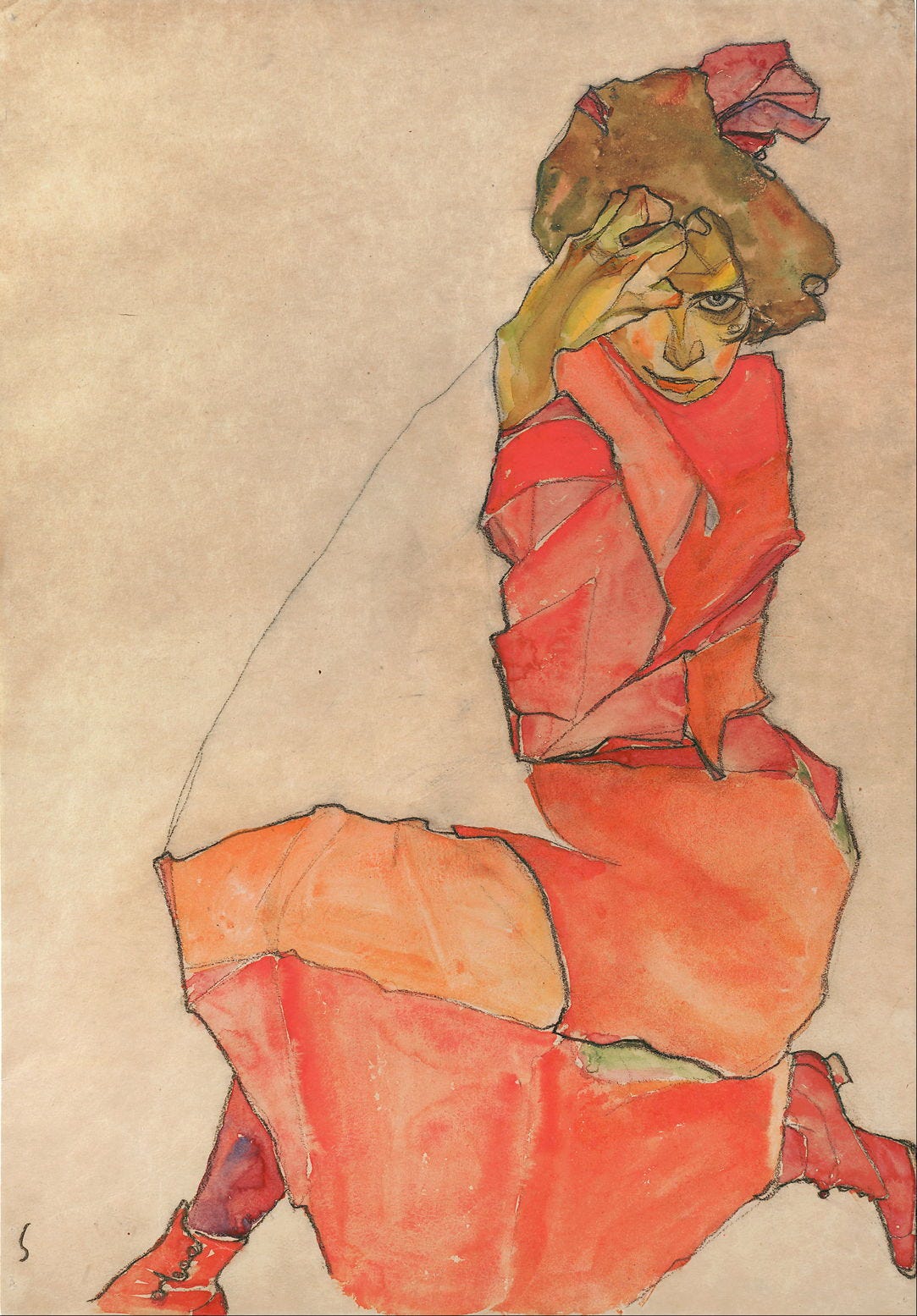
Gah, right?!? Look how Schiele uses the three elements of composition. Look at those negative shapes! Look how he arranged the subject to create the negative shapes at the bottom, how graphic and moody and striking it is! The composition!! AHHHH I LOVE IT SO MUCH!!!! And yes I’m shrieking.
Here’s another:

SO GOOD. An Austrian painter (b. 1890) Schiele studied under Klimt and is known for his drawings and paintings of people (esp nudes) and landscapes. His work is full of harsh angles and surprising shapes created using negative space. I think we can all learn so much about composition by looking closely at Schiele’s work.2
And with that, let’s practice what I’ve been preaching. It will give you spatial powers beyond your wildest 30 Day artist dreams.
Let’s draw some negative space.
