


Thank you, David Hockney ❤️💛💙
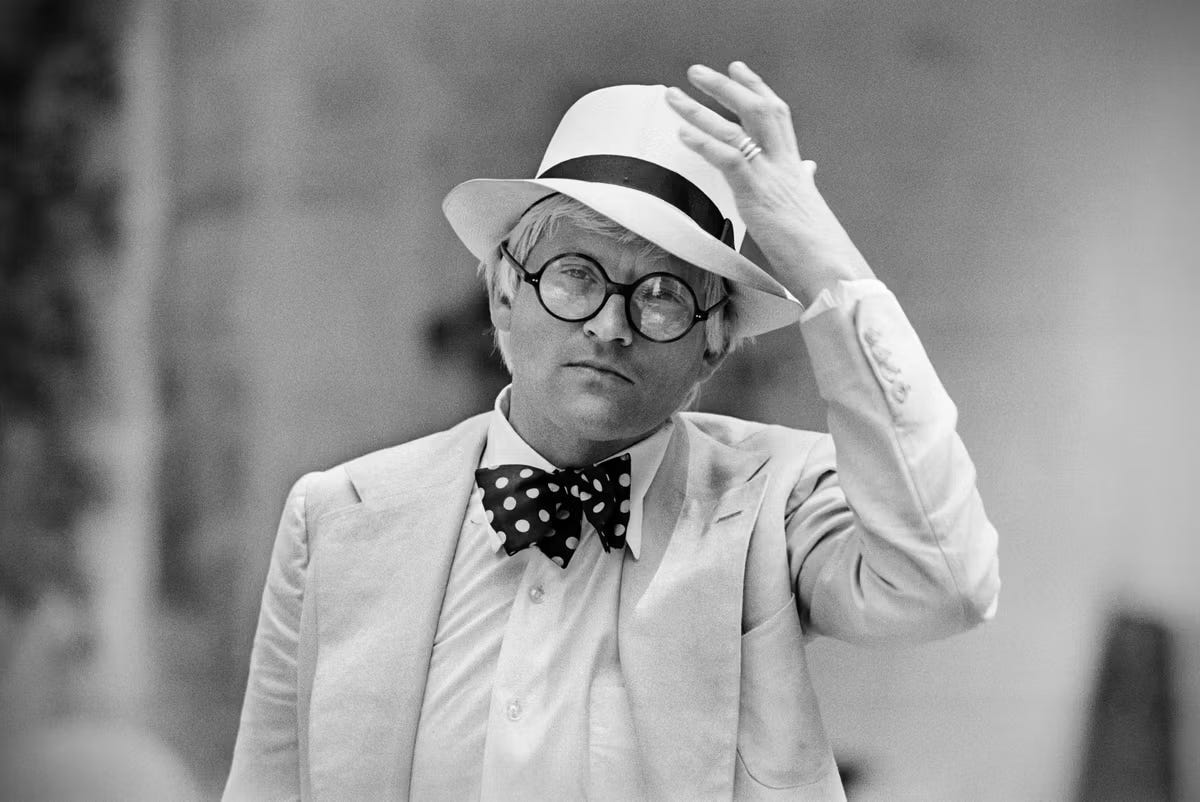
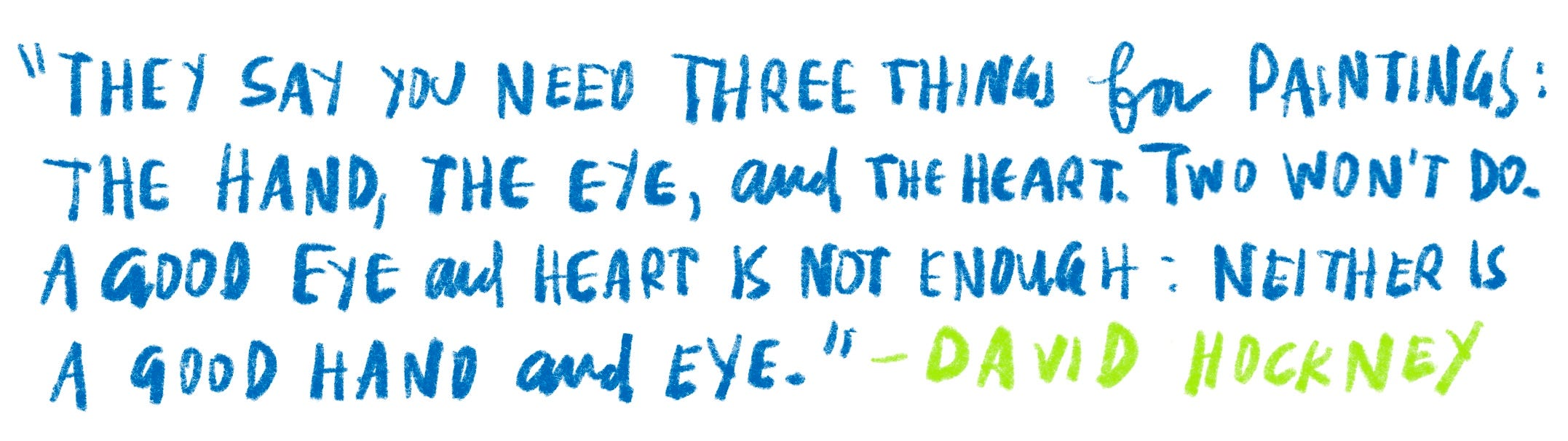
My dear Grown-Ups Table friends, this is Wendy. I’m popping back in again from book hiatus with an explosion of mint green tears and brick red hearts at the news that David Hockney, one of our great artists of the 20th and 21st century, hero to many (including me), a champion of close looking and attention and beauty and joy, died this week at 88 years old.
It only felt right to slam on the brakes, get out of the car, and take a good long look at the gorgeous warm light cast by his setting sun.
So I am going to take a moment—an entire Sunday, in fact—to celebrate Hockney’s life and work with you. Not just his colorful paintings, pools, and wiener dogs, but how he changed the way we think about art. How we look at art. How we see. Let’s take some time to reflect on what we’ve learned from him, then practice it a bit. To really make sure we recognize him in our creative DNA. I’m thankful to him for so much.
I am making this piece free for everyone, including the Hockney-inspired assignment and the GUT Member Gallery at the end. It’s a proven law of Newtonian physics: the more people who are inspired by Hockney, the more people draw, and the more people who draw, the better the world. So feel free to share this with a friend.
Here are a few things I want to thank David Hockney for today:
Thank you for your sketchbooks, David Hockney
Watch Hockney turn the pages of one of the hundreds of sketchbooks he filled with drawings made by looking closely at the world, quietly collecting and translating its lines and shapes and color over time. The Hockney Foundation holds 203 sketchbooks in its archives. (Remember to grab your sketchbook when you head outside today.)
Thank you for your curious mind, David Hockney
David Hockney dedicated years to exploring the history of painting, and in turn he helped us understand how we represent the world in visual art. Through his own practice, Hockney became curious about how artists represented perspective and focus in paintings, dating back to the Renaissance. After much study and experimentation, Hockney—along with the physicist Charles Falco—proposed the theory that painters as far back as the mid-1400s used optical technology like camera obscuras to help them paint.
While there is not much written evidence of painters in the 1400s using this technology, a close look at the artwork itself offers evidence of these visual aids: a depth of field that only a lens would perceive; perfect folds that are impossible to perceive and paint; a horizontal flipping of images. Some art historians are skeptical of Hockney’s and Falco’s theories. We will never really know. And personally, what I care about more than getting things right is the wonder. The endless curiosity. I love that Hockney did the thing an artist does, in every area of his work: He paid attention, looked closely, and shared what he saw.
Thank you for pushing photography, David Hockney
Hockney’s interest in optics and representation led him to explore photography in an unprecedented way in the mid-’80s.

When it came to representing how people perceive the world, Hockney thought of photography as, well, a lie. Or at least a very limited representation of how vision works. A photograph captures a split second of time, freezes it from a single point of view, with no record of the shifts of perception that constitute how a human actually sees: stitching together a multitude of angles and depths over time to make sense of what is in front of us. Drawing from life does this, as we draw what is happening in front of us over time. Hockney wondered whether he could push photography to SEE more like a person, which led to his body of “joined photos”—photographs pieced together to capture a moment in time.

At his core, however, and for his whole life, Hockney was a painter and a drawer. He believed drawing is the foundation of art, and of seeing. So let’s focus on that.

There is so much to say about Hockney’s drawing and painting. Some people know him primarily for his iPad drawings (which are amazing and giant and opened up new creative and technical possibilities for him) or maybe through his painting Portrait of an Artist (Pool with Two Figures), which happened to sell for $90.3 million in 2018 (making it the most expensive work of art by a living artist ever sold at auction). Let’s start there. Because more interesting than the painting’s price is the loving queerness it represents.
Thank you for your queerness, David Hockney

Hockney had been painting queer subjects since the early ‘60s in London, when it was taboo and legally dubious to do so. When he moved to Los Angeles, not only did he not shy away from featuring gayness in his drawings and paintings, he centered it. Hockney worked on Portrait of an Artist (Pool with Two Figures) for six months, got stuck, destroyed it, and then repainted and completed it in two weeks. Portrait of an Artist features a loving depiction of his partner of five years, Peter Schlesinger, also an artist. It’s an homage to Peter and to their life together. The film A Bigger Splash is a docudrama about their relationship, break up, and Hockney’s painting. Watch the trailer.
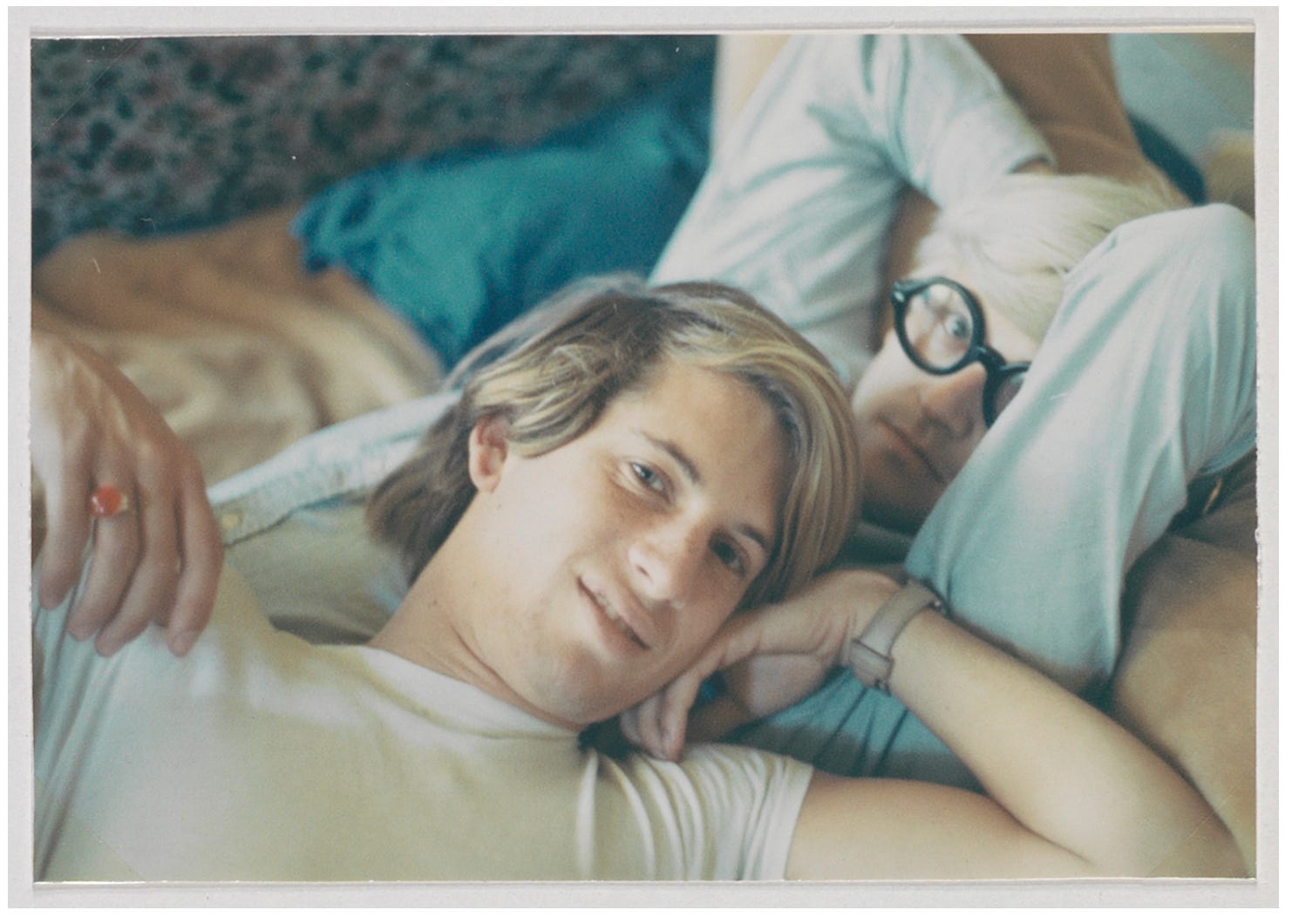
His many drawings of Peter, made over approximately five years (1966-1971), are a joy to behold. They are full of love and attention, drawn with care, tenderness, and desire.
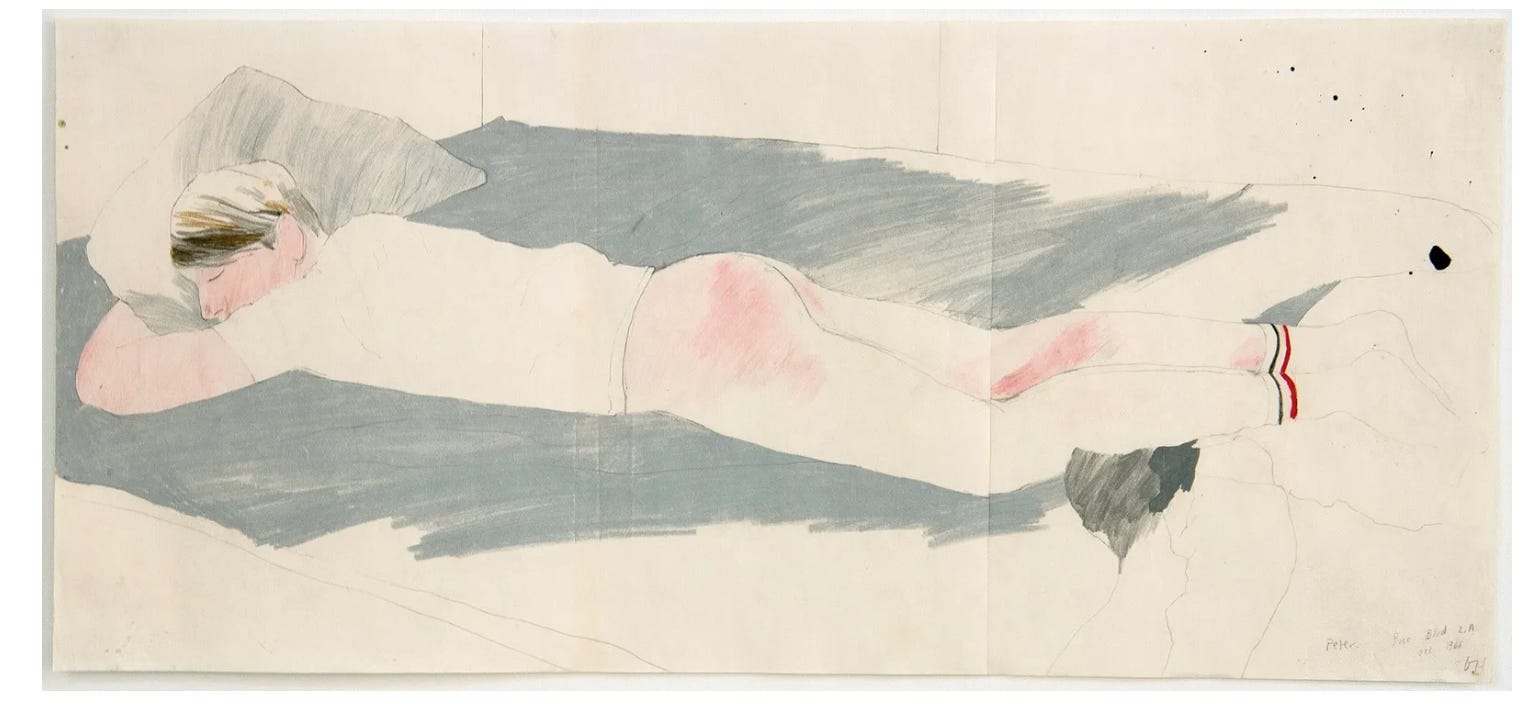
Drawing people is deeply intimate. It’s the closest you can get to touching someone without any contact. If you have ever drawn someone you love, you know what I’m talking about. If you haven’t, this might be the time to try.
Thank you for your portraits, David Hockney
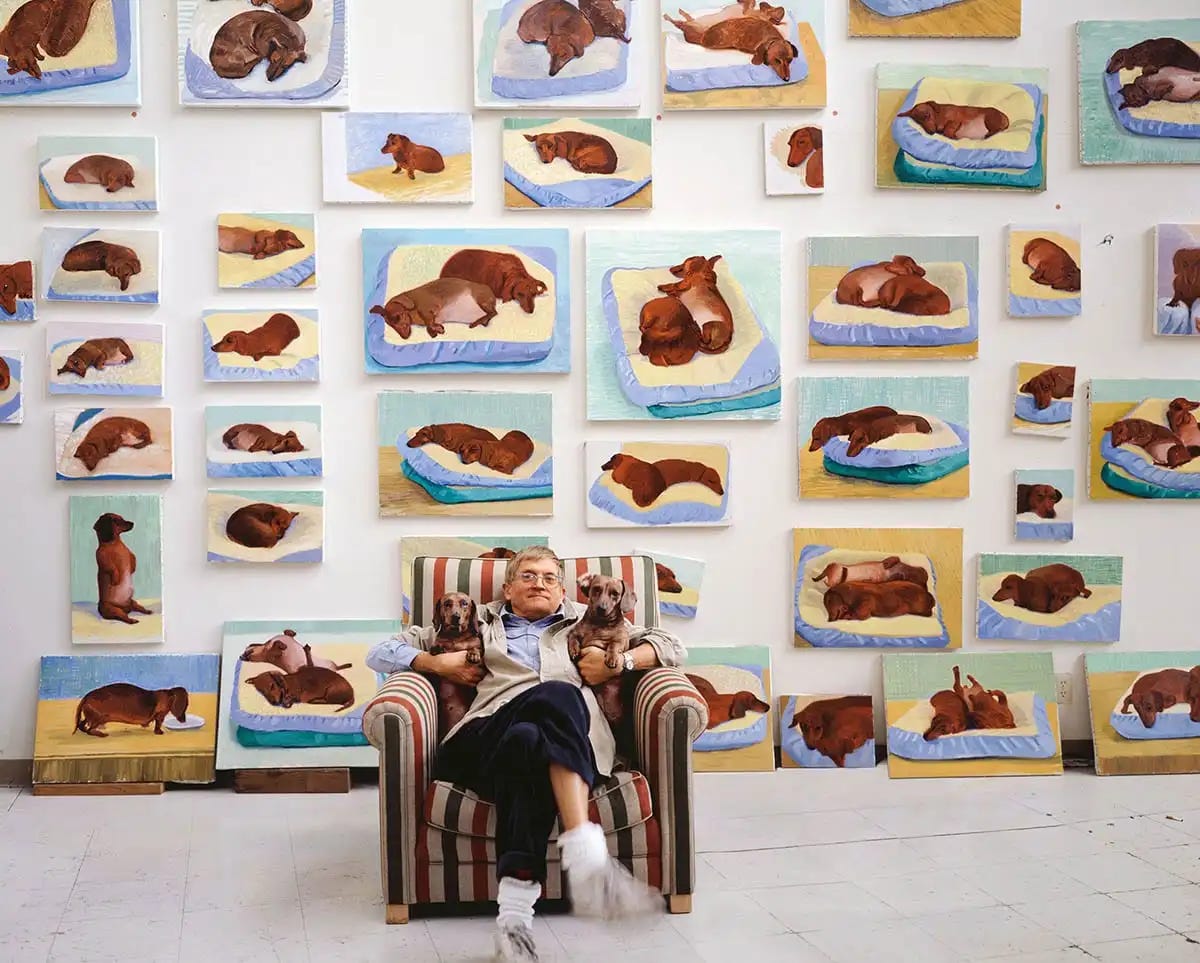
In the 1960s, Hockney began drawing portraits. LOTS of portraits. Friends, lovers, authors, artists, always his closest friends and colleagues. And his canine companions, of course. He would draw them from life, in real time. For Hockney, so much of drawing was about TIME (see the photo stuff above). He regarded drawing (and painting) as an intimate act of looking. Drawing a portrait of a person from life takes time, care, total attention, and vulnerability of both sides. Hockney spent real time with people: looking, noticing, joyfully celebrating them with color and line. (What else in modern life does that?) And he was the best at it.
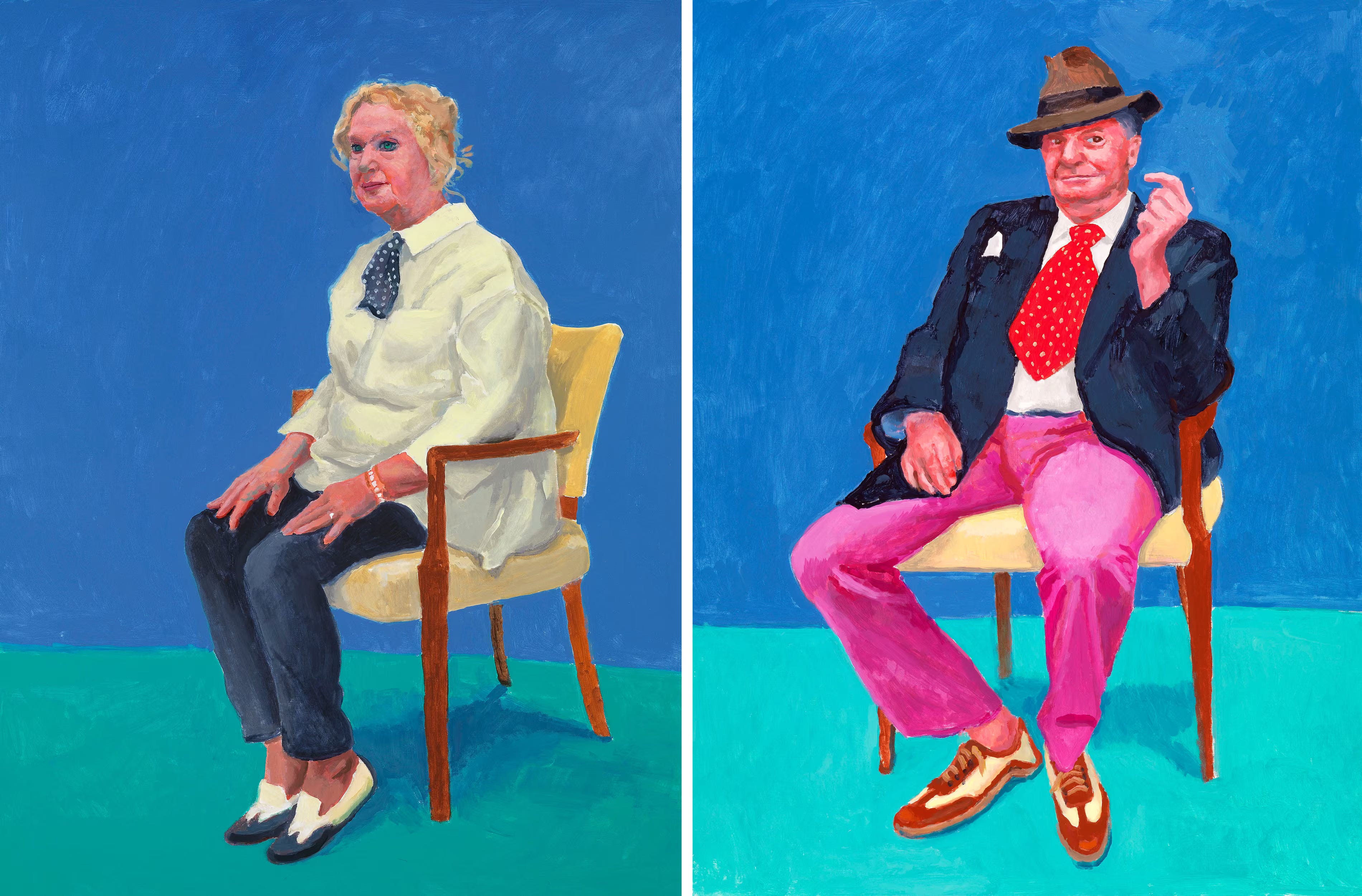

His earlier drawn portraits, made with pencil, pen, or crayon/pastels, reveal a delicate, careful eye, hand, and heart:
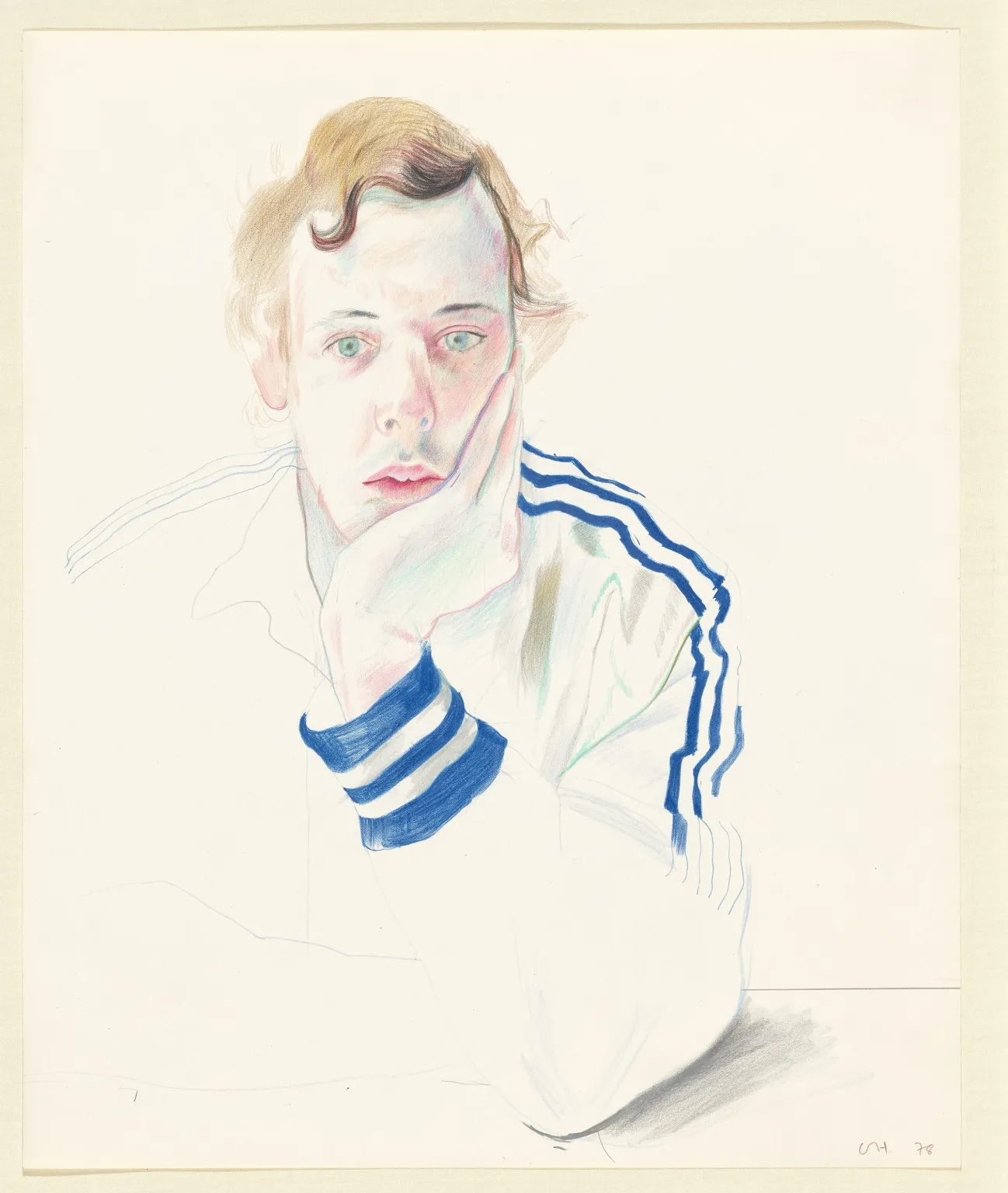
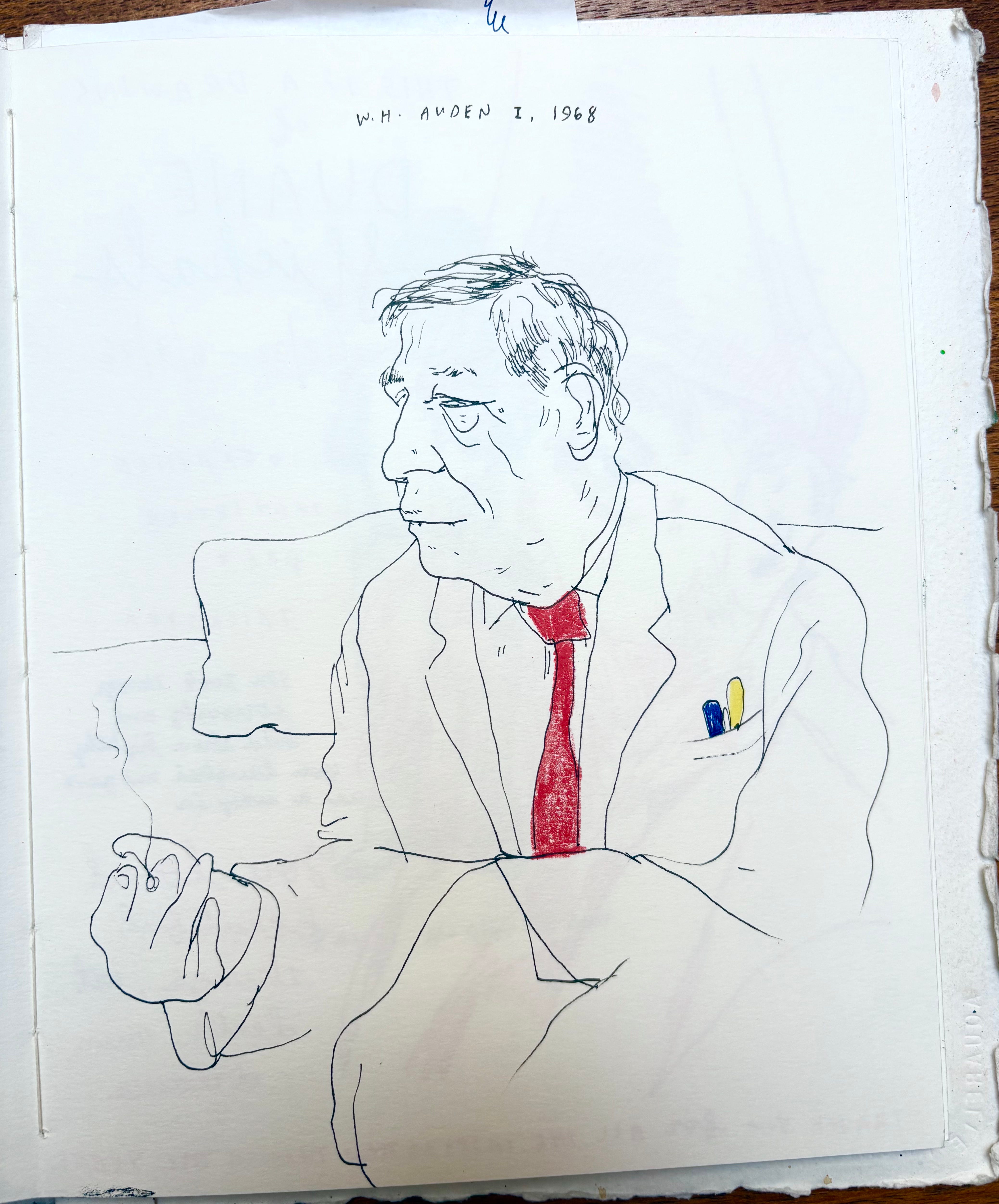
This is one of my favorites. There is so much love in his lines. The negative space, the color. His choices are confident and playful and also careful. I just love it.
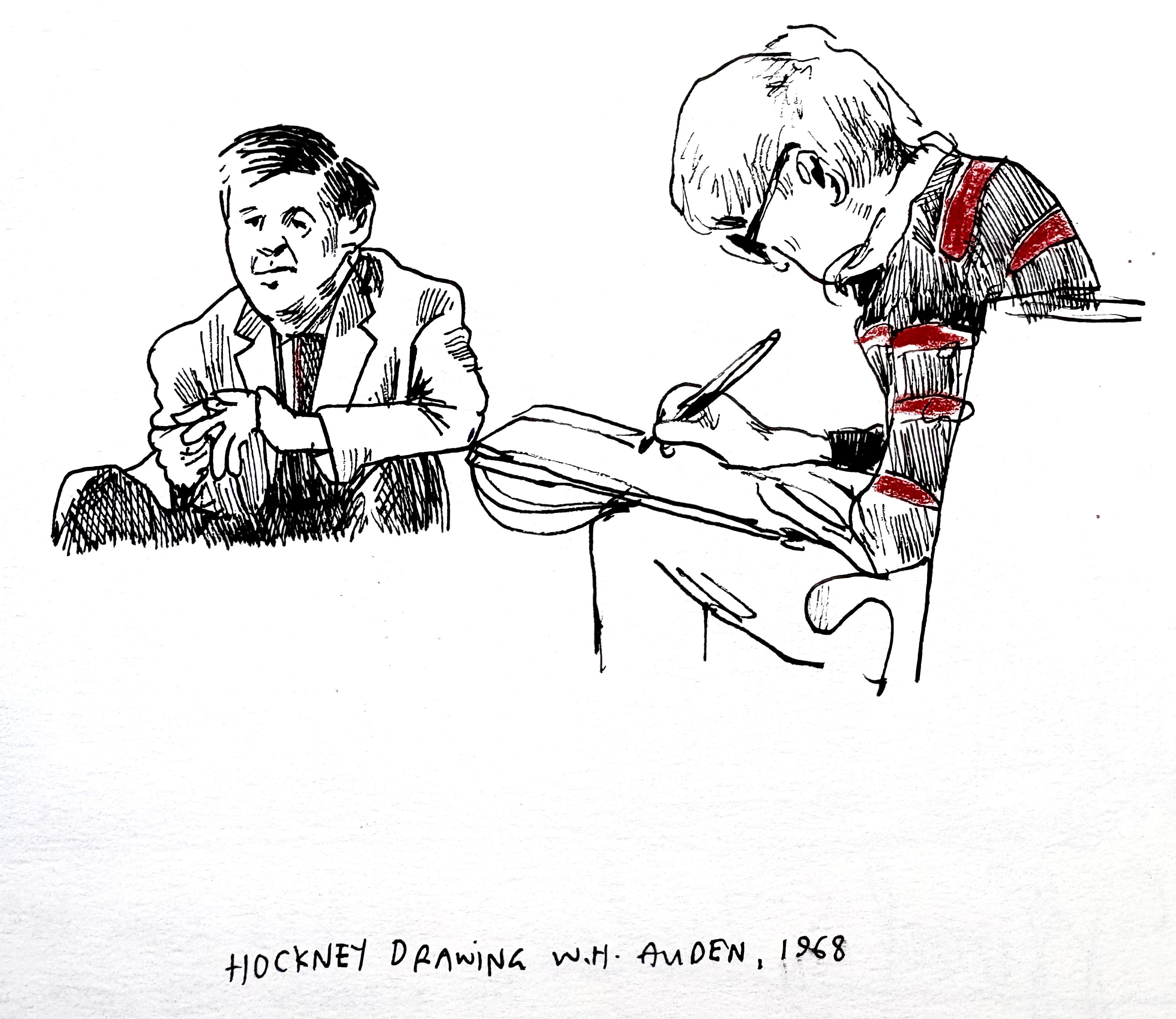
Here is a line drawing he made of Auden in 1968.
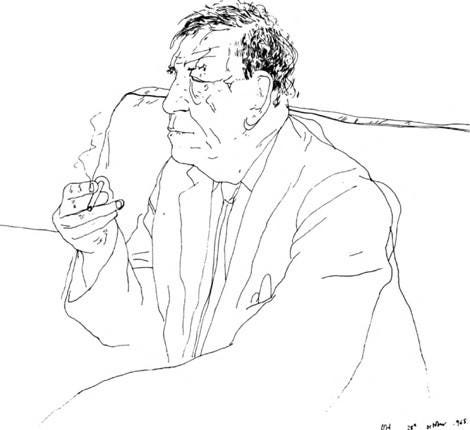
And here is a drawing I made of Hockney drawing that portrait Auden. It’s the most honest way I know to celebrate people. Words fail. Time looking does not.
Thank you for your landscapes, David Hockney
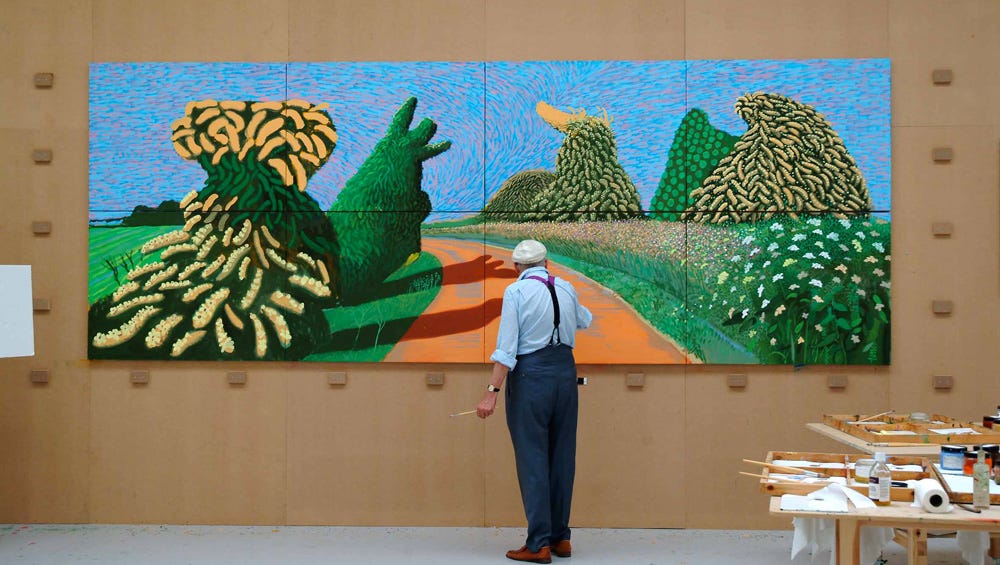
I highly recommend the fantastic documentary David Hockney: A Bigger Picture. It gives a real sense of who he was and how he worked in his later years. (You can rent it here. It is also available for free via the Public Library/Public University film collection Kanopy.)
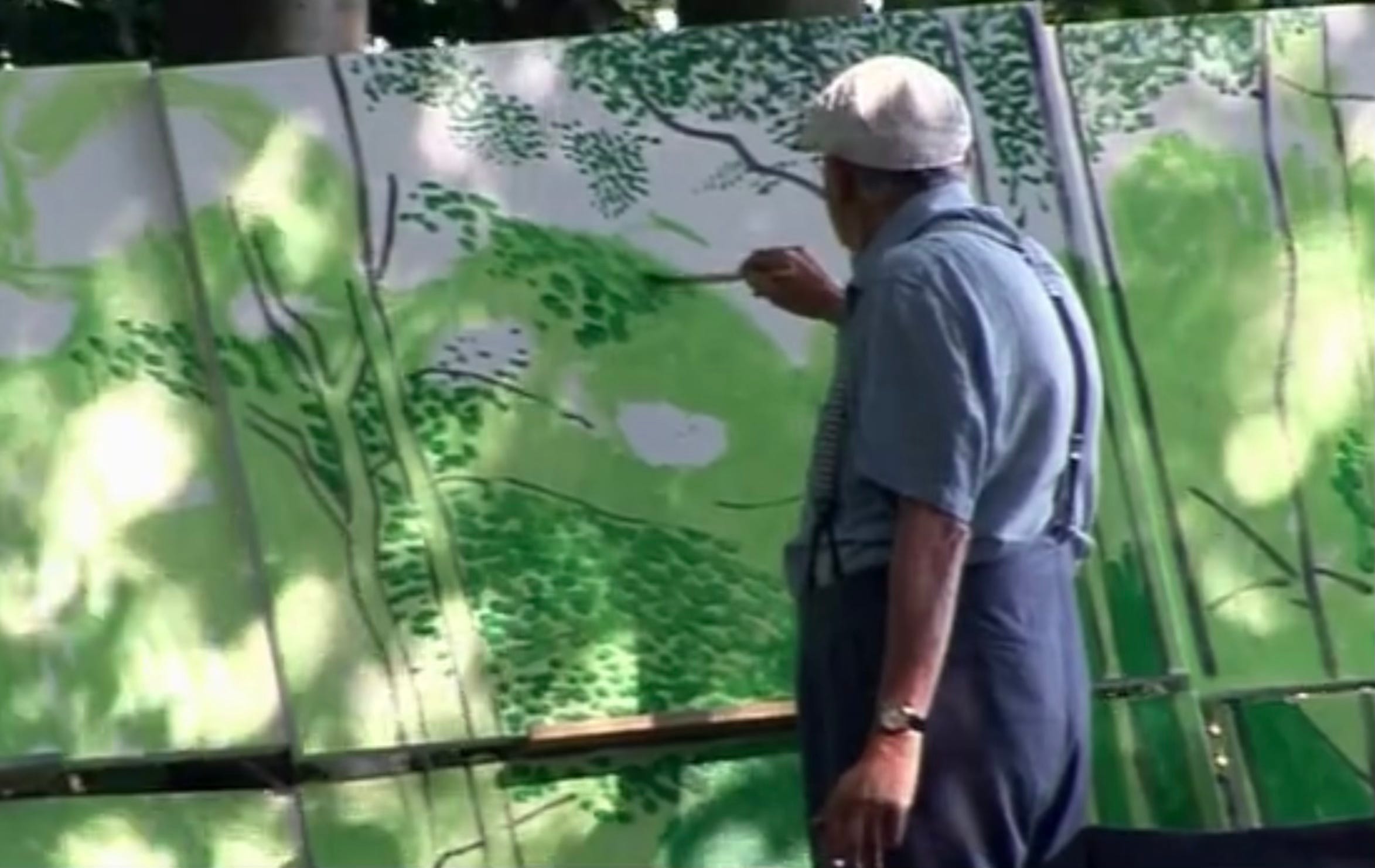
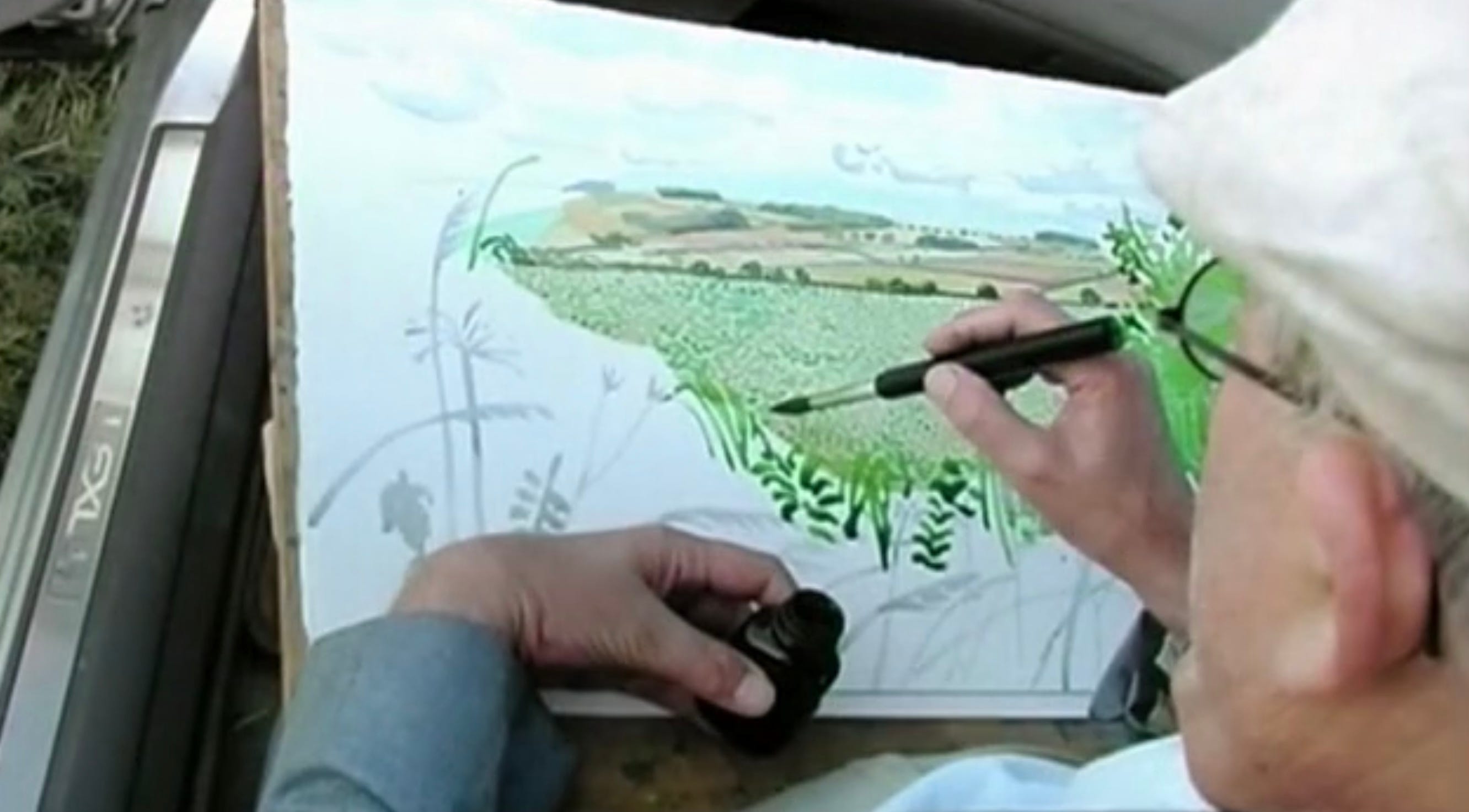
A Bigger Picture is a short, intimate, phenomenal documentary that follows Hockney’s return to his home in East Yorkshire, and his return to the most immediate approach to painting: plein air. (Plein air = painting on location.) This is the first time Hockney allowed anyone to film him painting, and he agreed under the condition that only one person could make it: the filmmaker Bruno Wollheim. No other camera people. No sound people. Just Bruno and a camera and Hockney for three years.
Below is an outtake from the film, which offers a revealing peek into how Hockney thinks and paints, and how he thinks by painting:
In conversations with the filmmaker, Hockney discussed the opportunities and limitations of painting and photography, the experience of making plein air paintings, memory, and why nature is the ultimate, infinite subject. The film also captures Hockney’s wry spirit, clever wit, and learned thoughtfulness. He continuously challenged assumptions and changed his mind—and his work—all while following the thread of making pictures.
Here are a couple stills to get a sense of how he worked. Honestly, it’s just like you and me, though maybe a bit bigger, and with an assistant or four. ;)
And finally, because I just can’t leave it out…
Thank you for your pools, David Hockney

As the story goes, Hockney fell in love with pools in 1964 aboard his first flight to Los Angeles. Coming from the UK—a place without the same climate or plethora of outdoor pools—he flew over LA and was struck by all those surfaces from above, reflecting the California light. Tiny scattered sapphires.
So Hockney began drawing pools. He made etchings and photos and paintings of pools. He placed his lovers and friends and even himself into his paintings of pools. He lowered himself into the empty pool at the Roosevelt Hotel in LA and painted its interior using a paintbrush mounted to a broom handle.
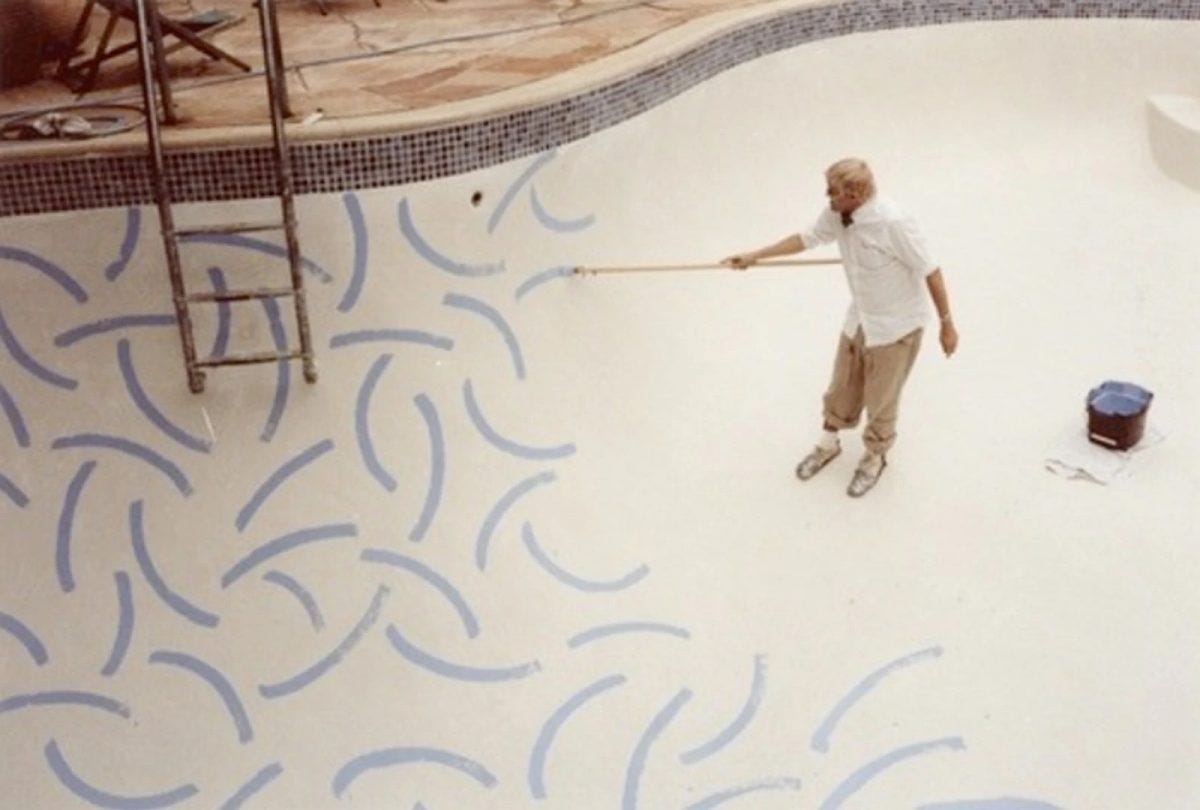
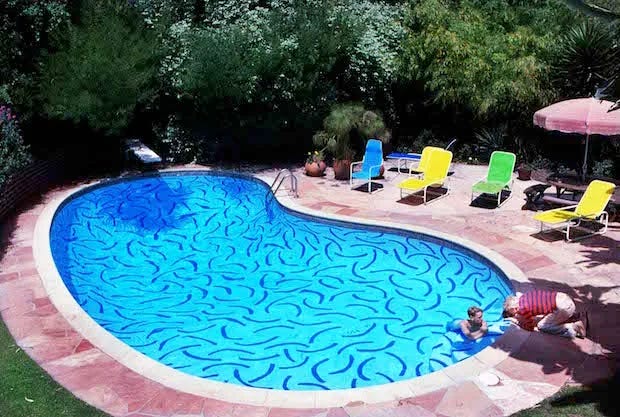
If there are two words we can take away from his pool paintings, they are: WHY NOT.
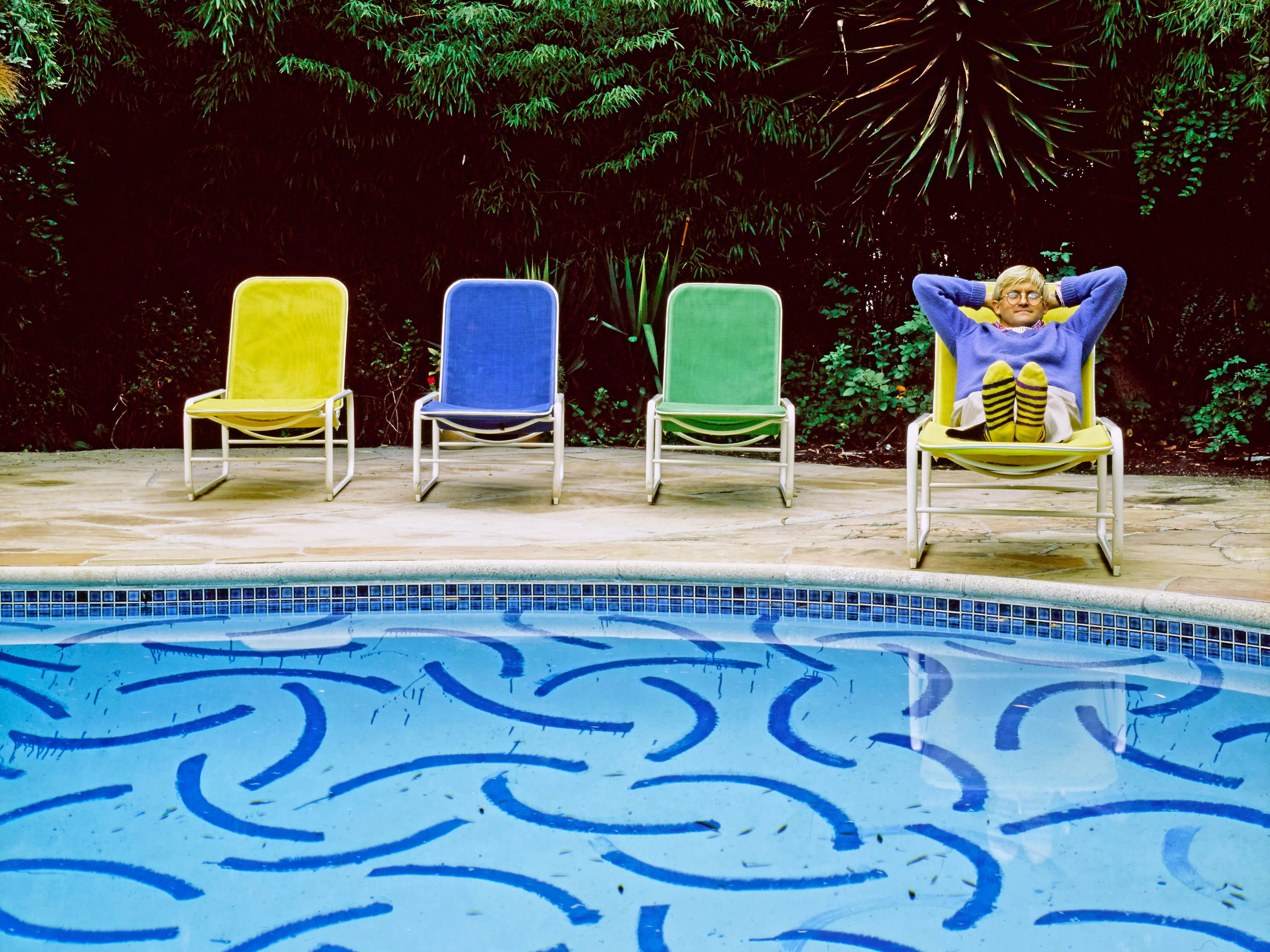
Thank you for inspiring us to see and to be, David Hockney
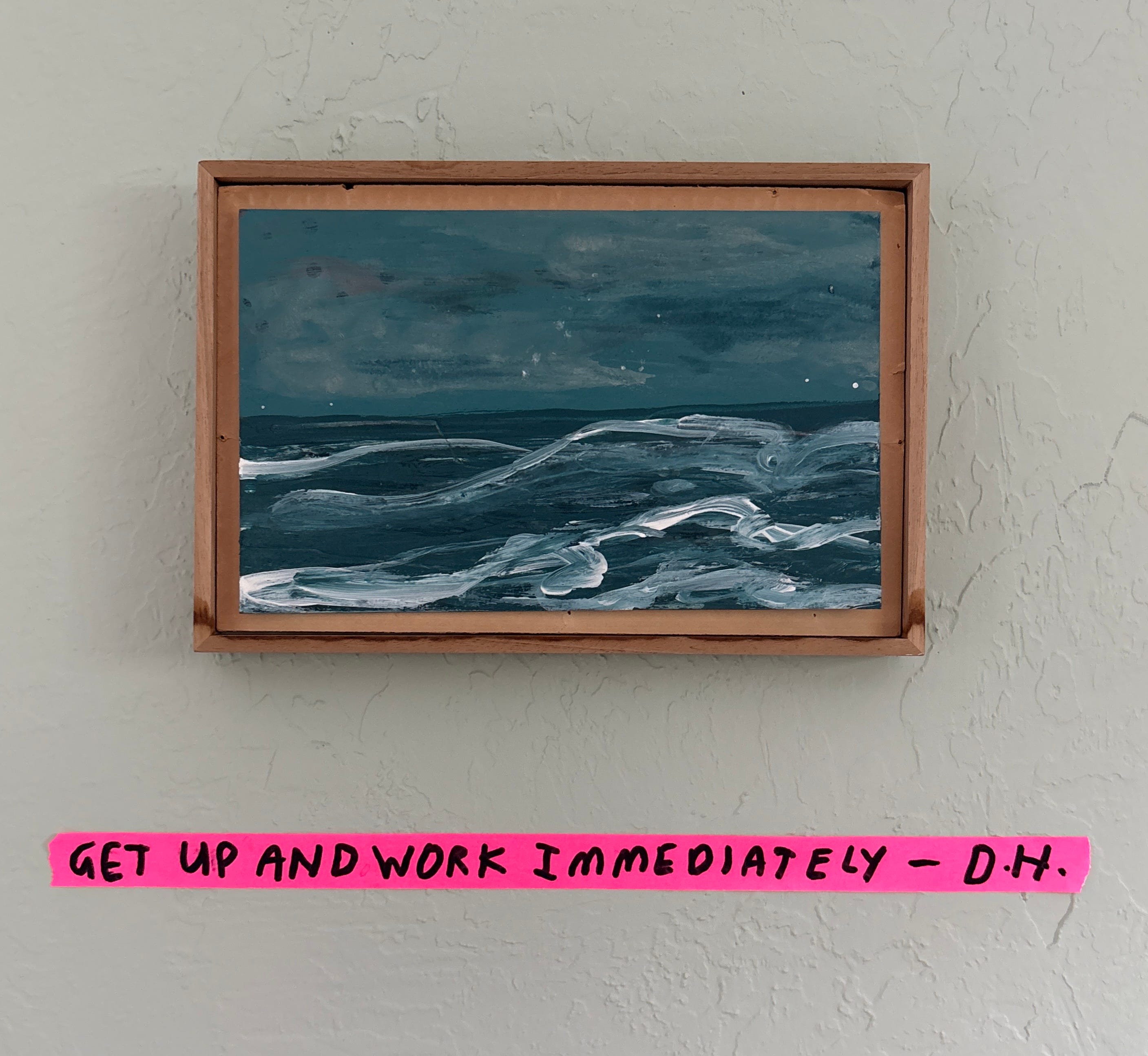
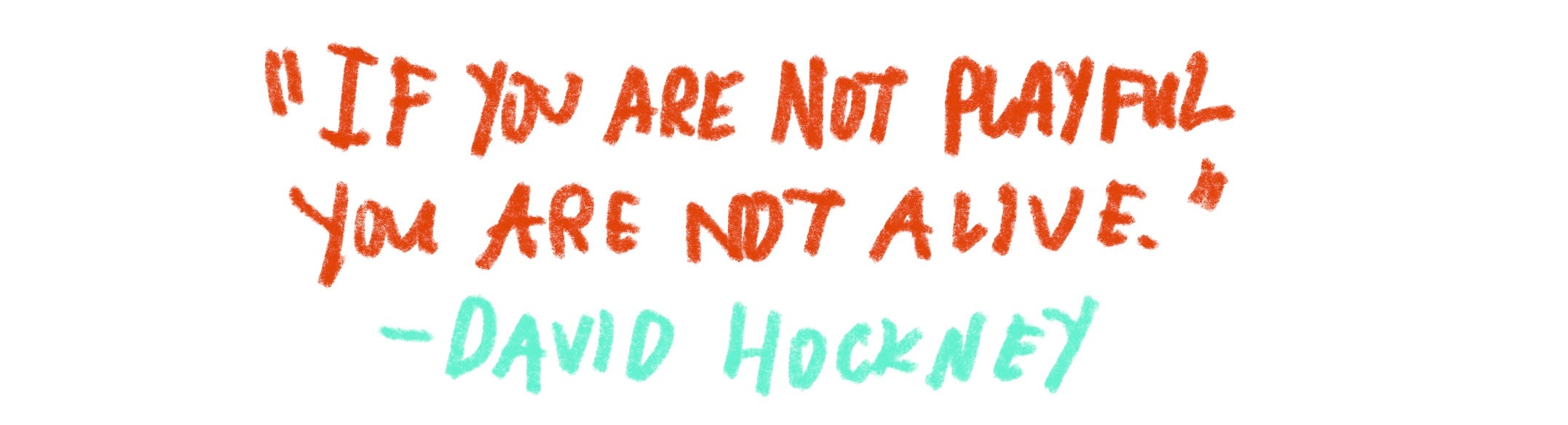
This is on the wall of my bedroom. It is the first thing I see every morning. It’s a painting by Tucker Nichols that I love (my room is tiny and in a city—this is probably the closest I’ll get to an ocean view for a while). The quote underneath is by Hockney. He painted these words on a bedside table in London as a reminder not to waste time. When your work is what you love, it is a gift to get to do it. But from time to time (like when we are working on an epic marathon of a book project -cough) we all need a little reminder to rise, shine, and focus.
All of this—his sketchbooks, his photos, his portraits, his landscapes, his broomstick painted pool—are reminders both of one person’s passion and commitment, and also of what WE are capable of doing, too.
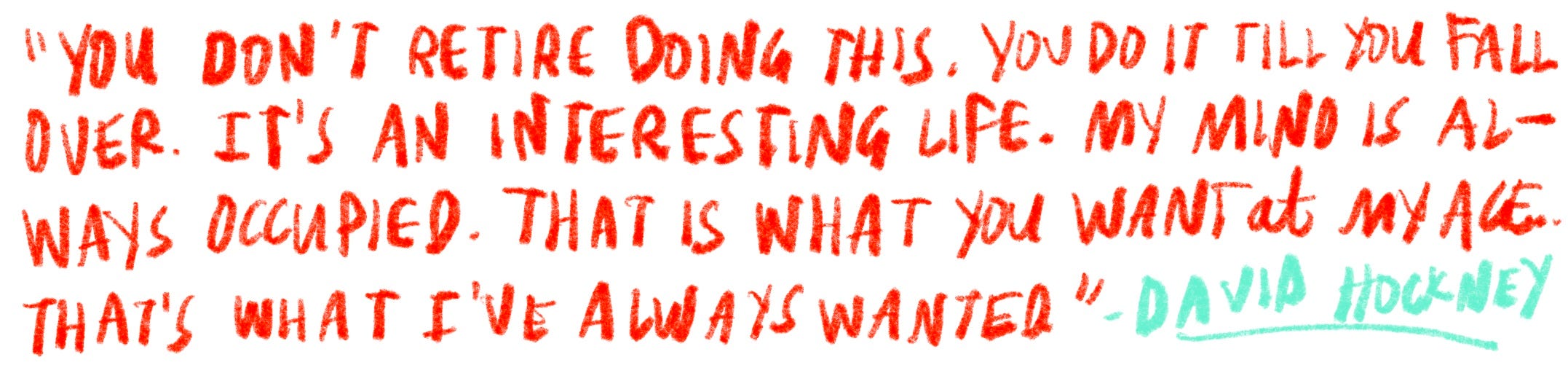
Hockney drew and painted Every. Single. Day. He shows us what’s possible in a life. If we want to draw every morning for 20 minutes but aren’t, we can. Hockney carried a sketchbook with him much of his life, looked at the world around him, gave it his attention. How lovely that by making something and sharing it, we get to see his world through his eyes. Even after he is gone. (Perhaps that is the point of art. To step into an artist’s shoes and see the world through their eyes, hearts, and hands.)
Thank you David Hockney for living your life in a way that inspires me, and so many of us, to live our own: freely, creatively, colorfully, joyfully, unapologetically, with curiosity and care.
Fireworks in our hearts. Pools in our eyes. Sunlight in our hands.
Pencils up.
xoxo,
w
Assignment:
I am offering you TWO drawing assignments today. You can choose one or both.
The hand and heart
The first is to find a drawing by David Hockney that speaks to you. You can look online, or better yet, go to a bookstore or library and find a book on his work. Maybe it’s a portrait or a landscape or an object or who knows. And then COPY IT. We don’t do this often in the GUT, but the practice of copying artwork by “the masters” is fundamental to any art school education. By copying the strokes and movements of another artist, we learn HOW they made something, and teach ourselves new ways of seeing and making.
By drawing in Hockney’s shoes, if you will, we build those hand and heart muscles. And by sharing that drawing with the rest of in the chat, we get to learn more about his work.
USE COLOR!
The heart and eye (and the hand!)
The second option is inspired by his portraits of both people and pets. Draw a person or animal that you love, deeply, FROM LIFE. They can be watching TV or reading, or maybe you are at a cafe together…but take 10 minutes and draw this person you love, and see what that feels like. And then share that drawing with us.
USE COLOR!
For members: Share your drawings in the GUT chat! I’ll join in the chat, too. See you there.
I can’t wait to see your Hockney homages. They will warm all our hearts.
GUT Gallery
It was a BLAST to meet a crew of GUT peeps last weekend at the National Gallery—turns out there is a DC-based GUT crew that gathered in person once a month to draw together. DrawTogether GUT crews around the world UNITE.
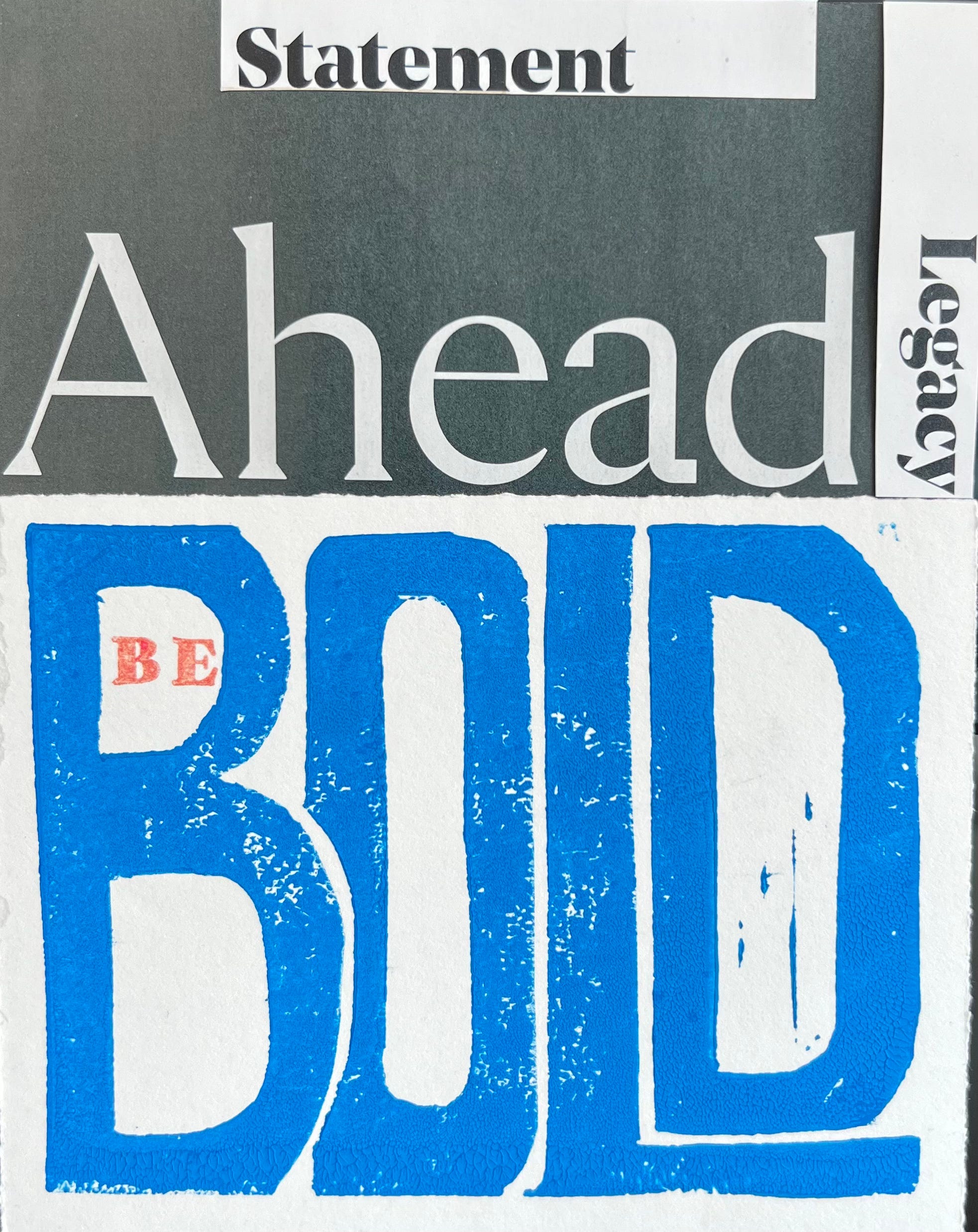
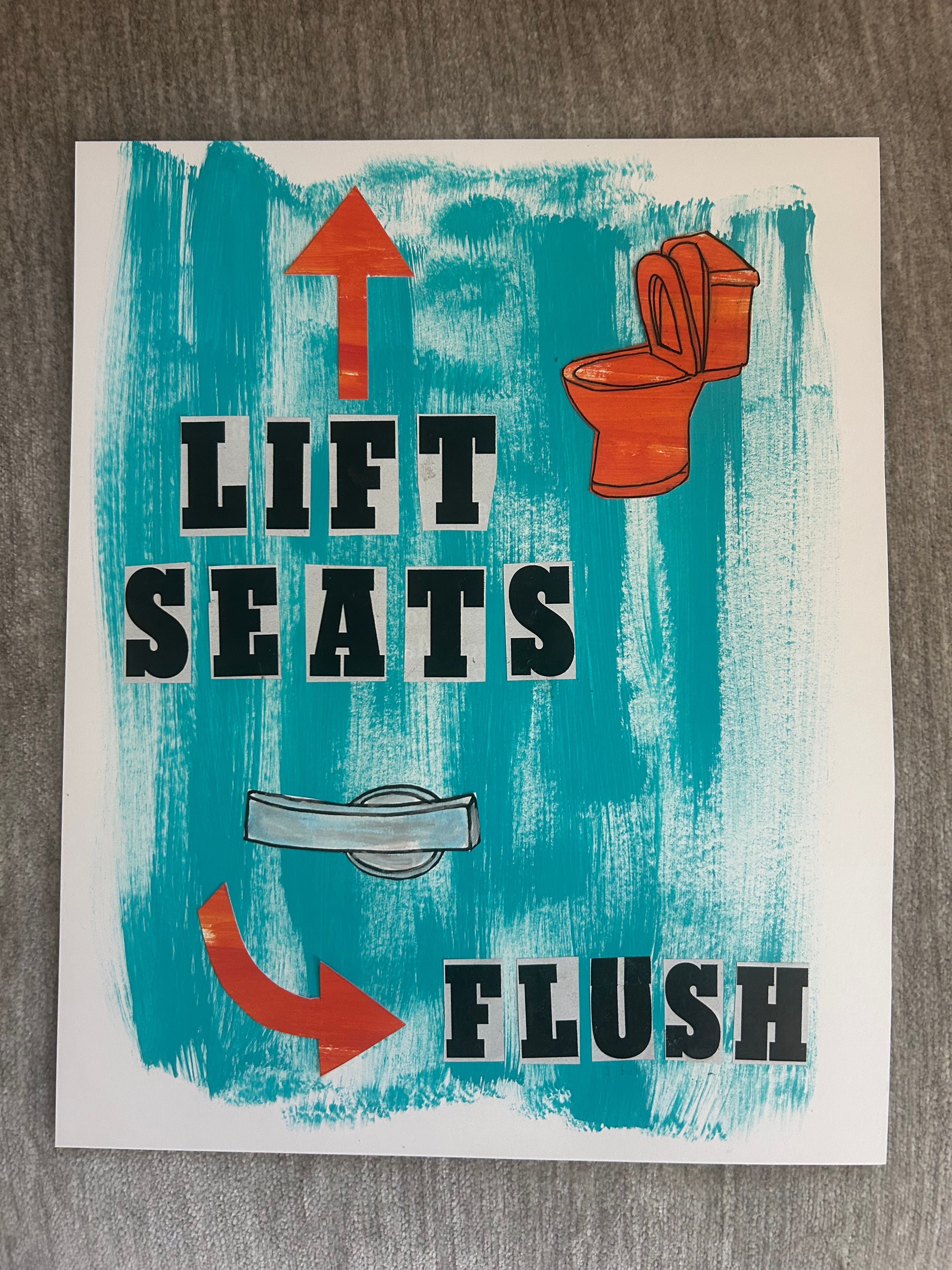
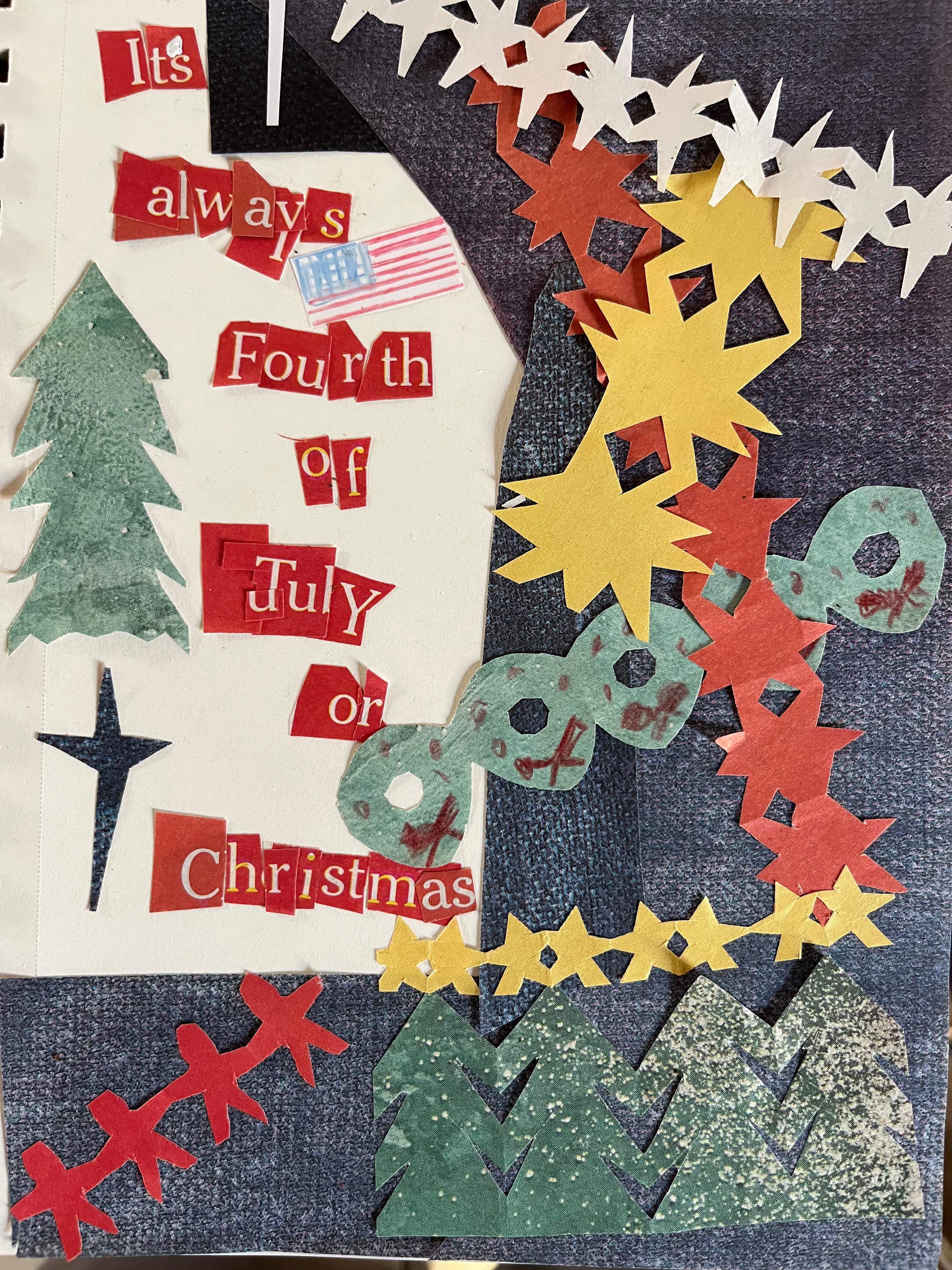
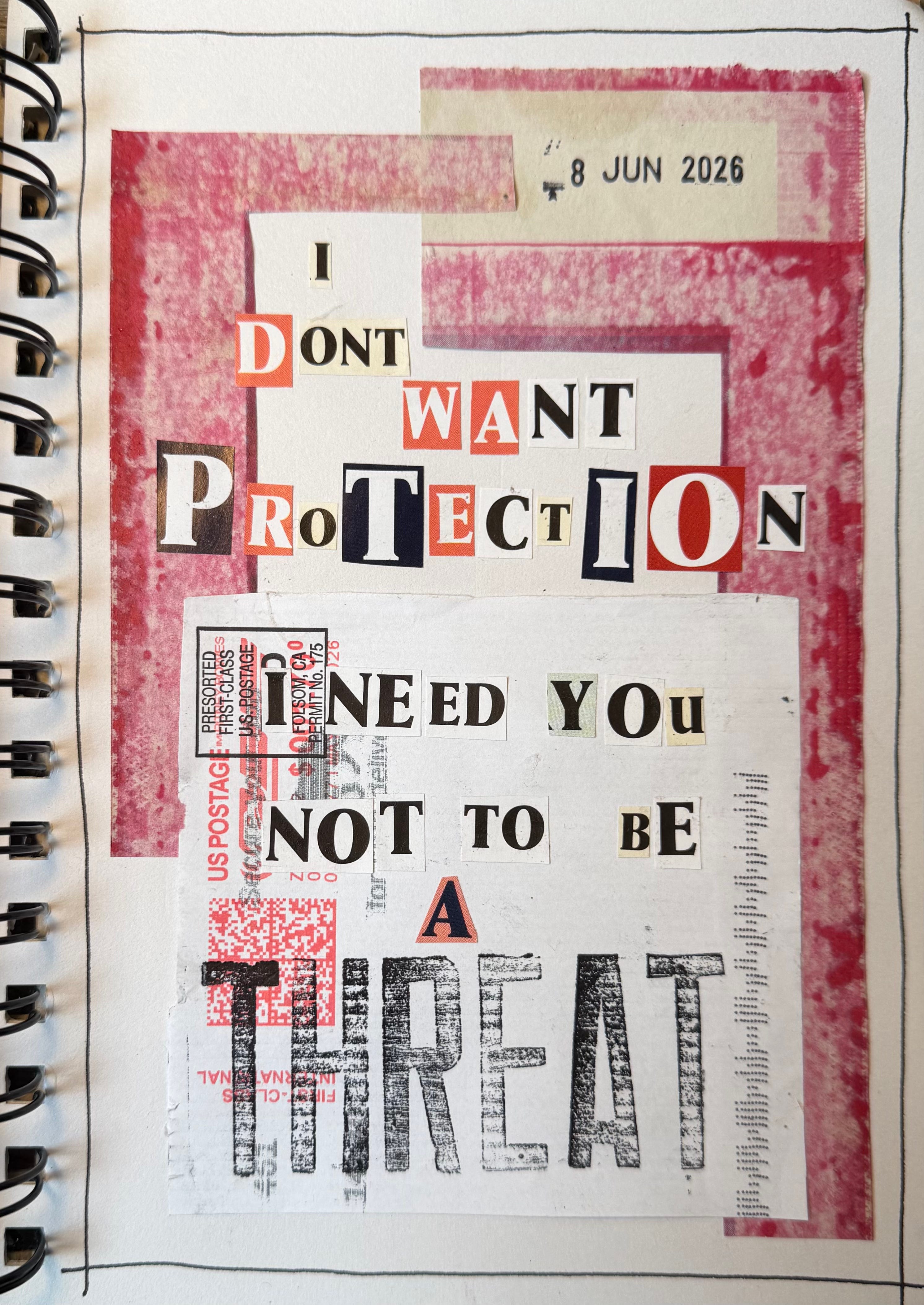
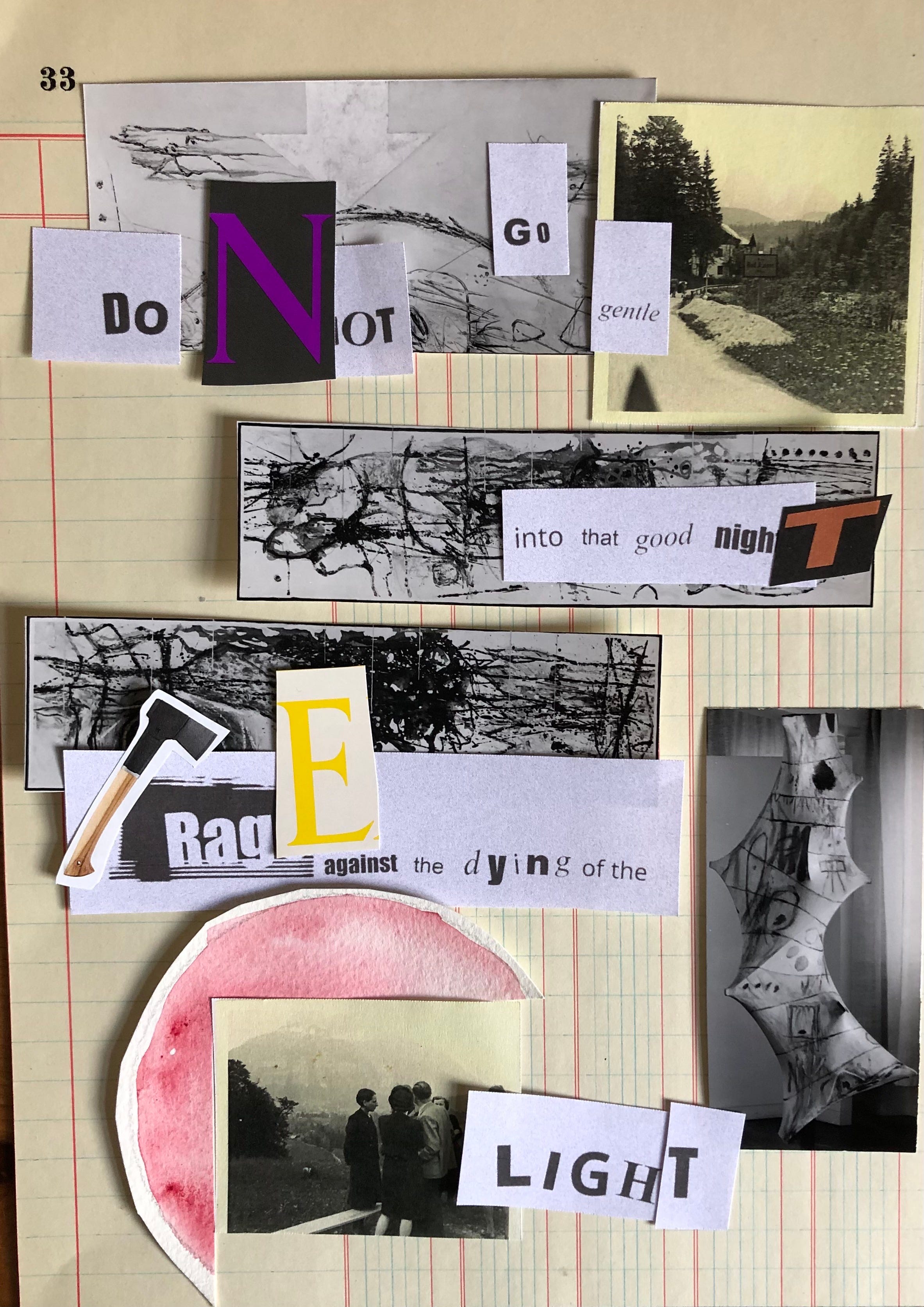
This week saw such an awesome collection of artwork in the GUT chat this week, all inspired by Sister Corita. Love seeing what you all make and create in response to our deep dives, lessons, and inspirations every week, and the deep community growing in the chat. Can’t wait to see what you create this week to honor our dear DH. ❤️💙💛
Bookmarking this to return to every time I need inspo. Thank you for amplifying Hockney’s invitations for us to see more deliberately.
My favorite artist, so much joy in all of his work