


Hi GUTsters!
We had a great time with Caroline Paul last week. We spent time gazing at the sky, experiencing awe, and (of course) drawing! How amazing to see all the pictures in the chat showing the sky’s changes through your eyes. Just beautiful! And FYI the winner of our Why Fly giveaway is at the bottom of this dispatch.
Now, onwards to our next adventure…
We might imagine Serious Artists (capital letters a must!) as people working in total, absolute silence, all the better to concentrate on their Serious Art (again with the caps, maybe even italics?). Meanwhile, we are over here, shamefully playing music or, gasp, even a movie in the background while we draw and paint.
But turns out all kinds of people (even Serious ones!) fill their ears while they make visual work. So this week, we are trying an experiment…
We are going to share about two artists we love and the music they listen to while they work. Then we will turn the tables and hear from the GUT’s own Chris Colin who, in addition to being an incredible writer, also makes music for people to draw to. Finally, YOU are going to draw while you listen to music, and we’ll see how music does/doesn’t inspire our drawing. Fun? Fun! Let’s do it.
Jenny Saville
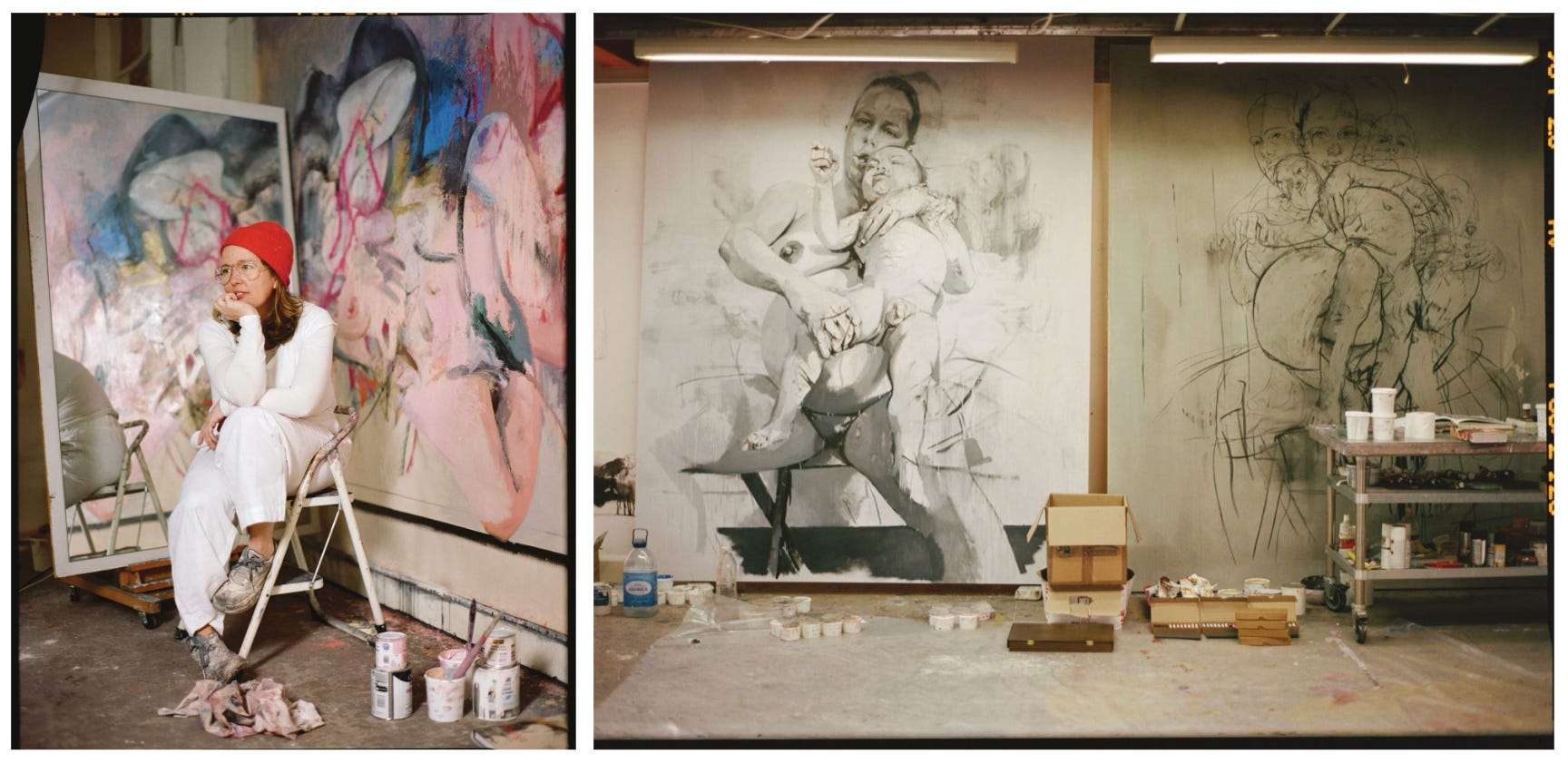
Jenny Saville is a phenomenal painter who combines classical training and influence with modern-day subjects and references, focusing on the representation of female bodies. She works at a GIANT scale, and often plays music while she draws and paints:
I’m pretty ruthless with music. I use music as a way to get in the right mood for what I want. I listen to things on repeat. So it's very annoying; if anybody were in my studio, they would just be going completely crazy, because I can listen to one single piece of music for the whole duration of an artwork, or even for a show.
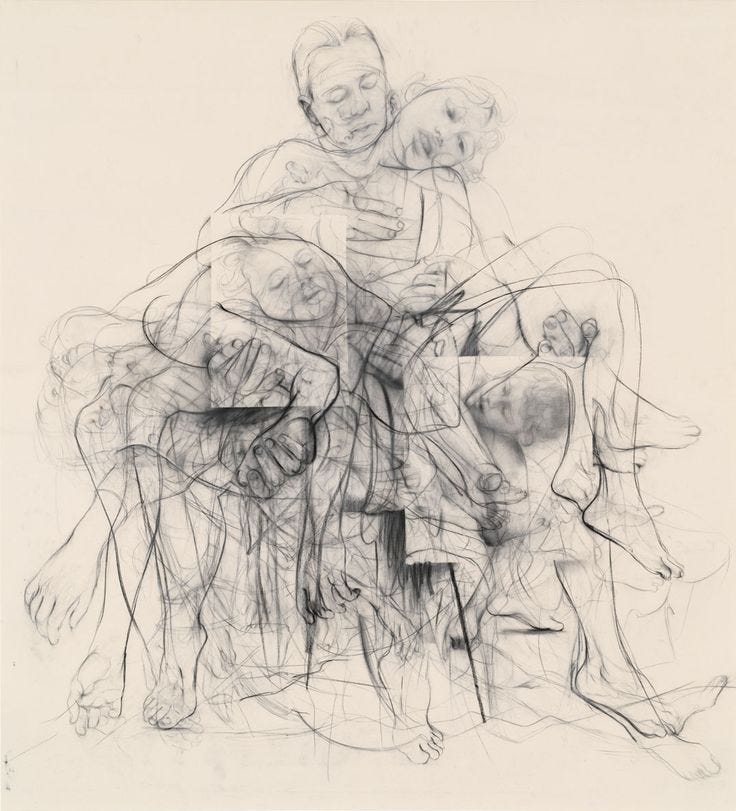
While Jenny worked on her Mother and Child series (artwork above and below), she played "Weird Fishes” by Radiohead on repeat. “The repetitions of sounds and the layerings were a good companion for me at that time. And there's an urgency in the music that I liked,” she says.
Hit the play button below and listen to it yourself. While doing so, look at the drawing below and see if you feel a connection of influence, or if the music takes you deeper into the drawing at all.
Rashid Johnson
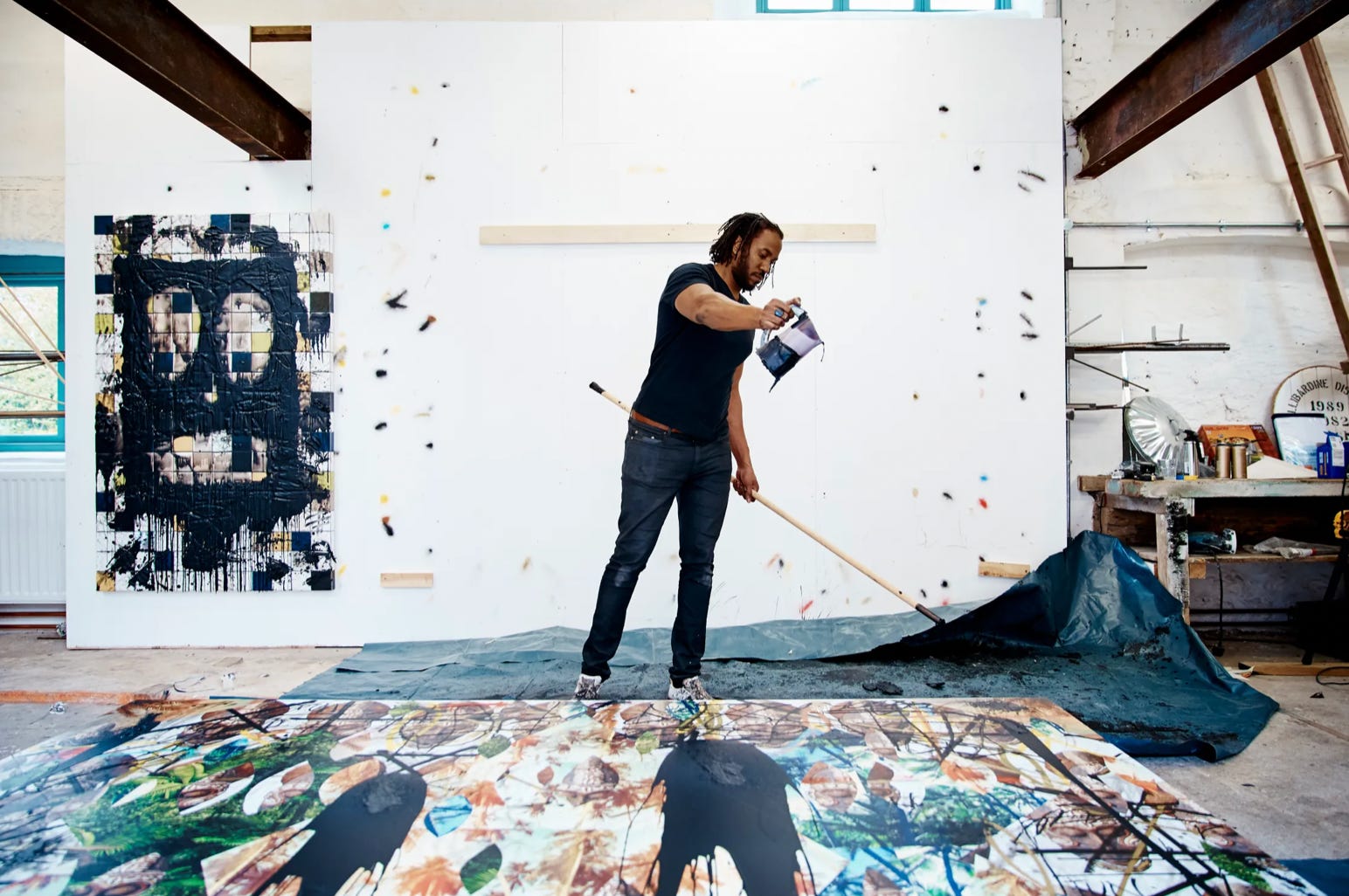
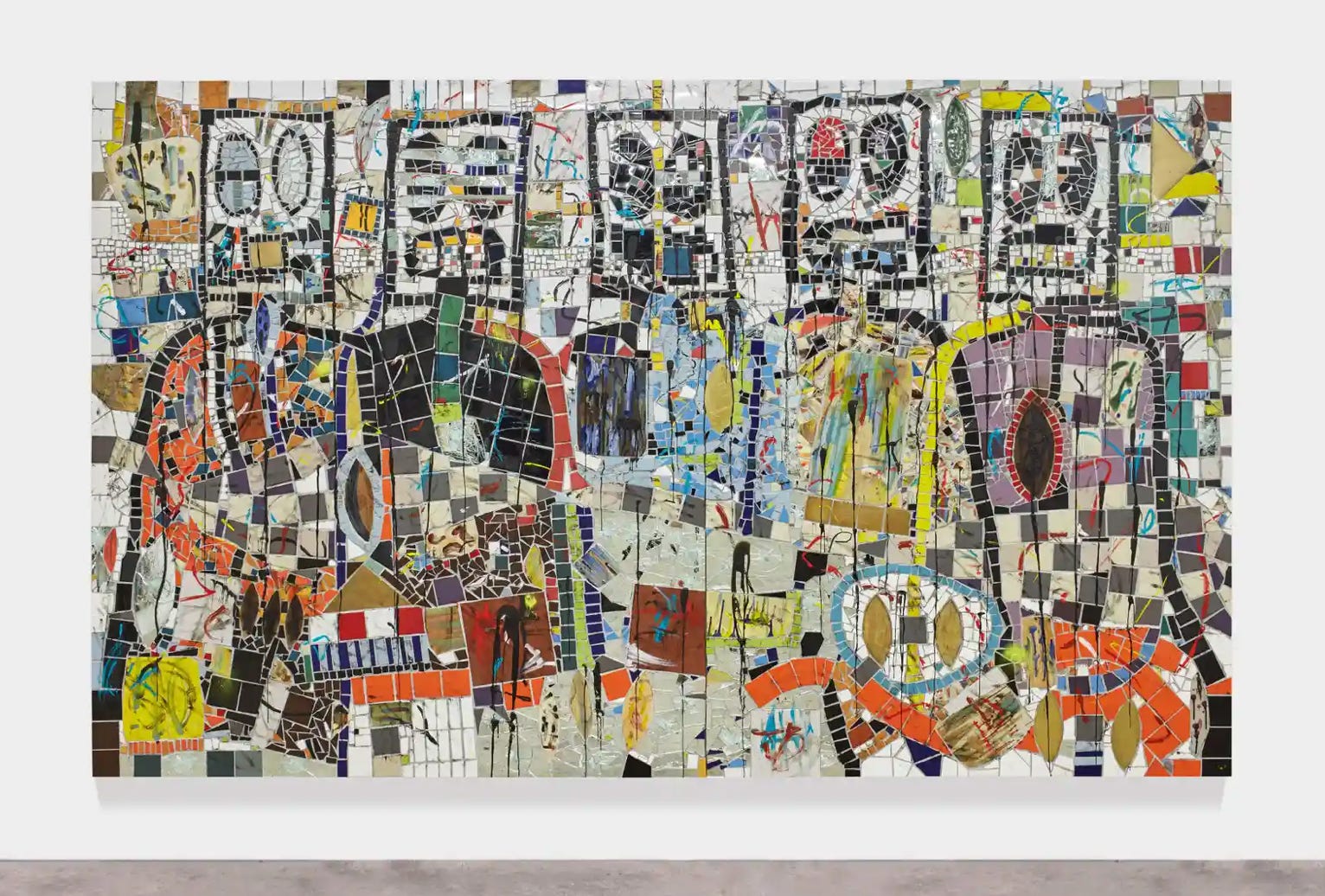
Rashid Johnson is one of the most exciting, respected artists working today. His career launched with a solo show in a prominent NY gallery at the age of 19. Shortly after, he was included in a pivotal show of emerging Black artists at The Studio Museum in Harlem, called Freestyle, curated by the fabulous Thelma Golden. Starting with photography and moving into multimedia sculpture and video, his body of work addresses history, art history, society, and self. While much of his work explores identity, he says, “My black-ness…[has] a strong effect on how my work is born and around the conversation that inevitably will happen, but I don’t think that it’s really the sum of all what my work is. And I think formally I’m trying to approach art-making in a way that is part of the bigger history of art.”
Turns out Rashid has a thing for jazz:
I’ve always had a real interest in improvisation and avant-garde jazz. So you'll hear a lot of Cecil Taylor in my studio, you’ll hear a lot of Ornette Coleman, you'll hear a lot of Art Ensemble of Chicago, some stuff that people would imagine as noise, some music that people may even be quite frustrated by.
Listen to “Lonely Woman” by Ornette Coleman below, and spend a few minutes looking closely at the artwork under it, by Rashid. See if you feel that connection or influence, or if the music pulls you deeper into the art.
It’s fascinating to see that both Jenny and Rashid think their listening habits would drive others away! But it’s what works for them. Like Jenny, Wendy finds that musical repetition plays a big role in her creative process as well: “When I’m really into a painting, I often loop the same song over and over as I paint. As a result, I forever associate the song with that art, book, or body of work. The song ‘Chickens’ by Junip will always remind me of Salt Fat Acid Heat, and ‘Business’ by Tune-Yards is the 6th street story in Meanwhile in San Francisco.”
Now let’s change perspectives and hear from the other side: a music-maker for artists!
Chris Colin

When Chris isn’t pitching in with the GUT, he is busy writing fascinating magazine stories—and coming not-very-soonish, his next book. But music was always his favorite art form, starting at 16. What started as a liability—he swears he can’t sing—became oddly useful, when he realized word-free music was perfect for soundtracks, odd art projects, and drawing.
We asked Chris to share more about the role of music in his line of work and also how he thinks about what others might want to listen to while making art:
As a writer, I often like a little background music when I work, but not to put me in a certain mood, or to spark ideas, or anything like that. It’s purely to nudge me into a kind of trance—that hazy dimension where the kitchen table melts away, the inner critic melts away, and I’m stripped down to more foundational thoughts.
When I’m making music, particularly for drawing, I aim for a similar dimension: tones and melodies that are interesting enough, but don’t clobber you into focusing on them instead of that pileated woodpecker you’re painting. (Yes I can see what you’re painting.) Pulling some guitar or a bass line or some keyboard out of a composition is often more important than whatever I initially add.
Then I just repeat it over and over like a maniac. I once read a great quote from John Lennon about the holy power of repetition in music. I have no idea what it said. But it was so persuasive that I remember the sheer fact of it. Anyway, lotta repetition involved when I’m making this kind of music, and if it has some kind of hypno-amniotic effect beneath the surface, hell yeah.
Thanks, Chris! It’s so neat to see how the role of repetition keeps coming up in folks’ processes! We’re delighted to have you with us on this journey, and to have some of your music to share with our members!
And now it’s your turn!
